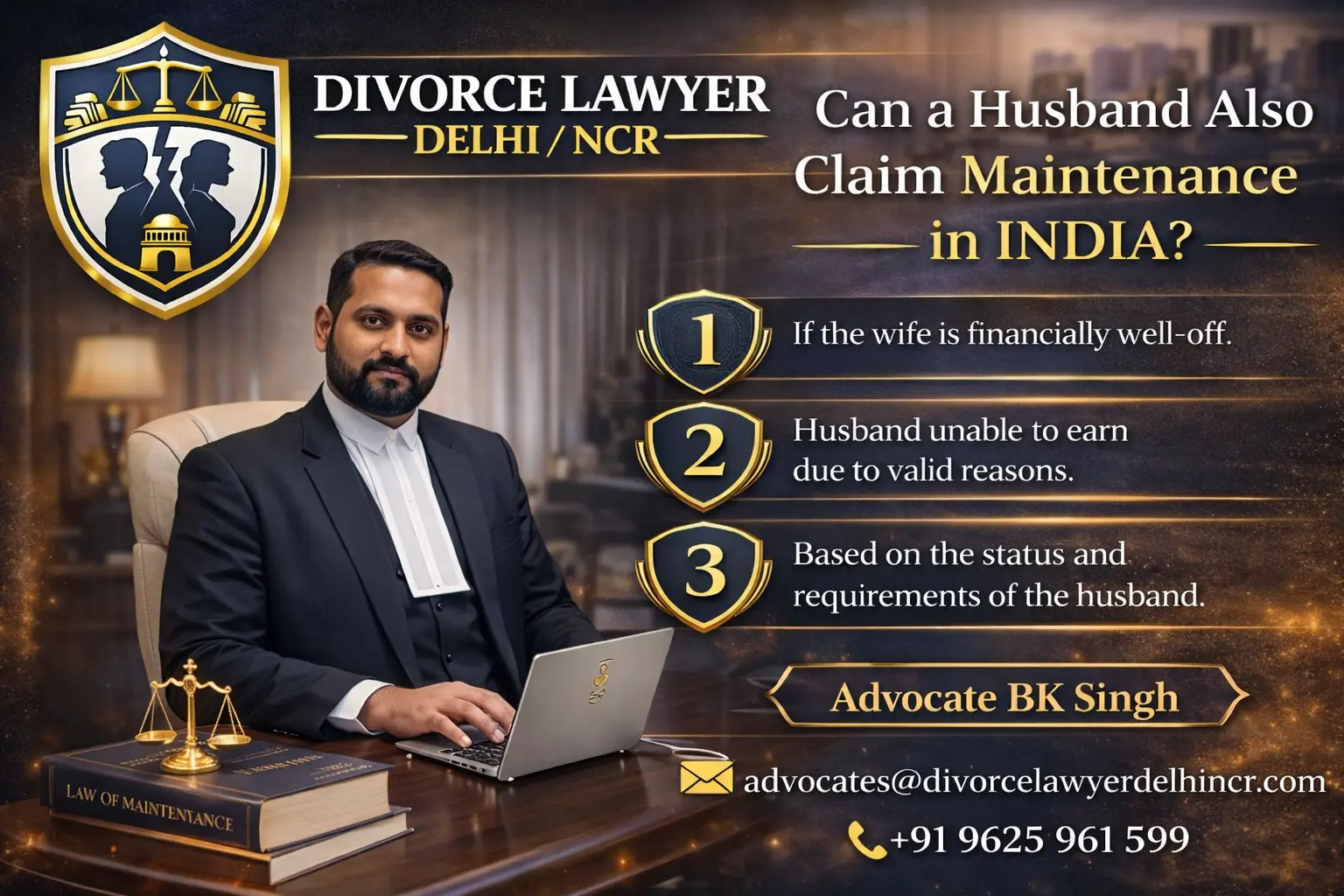
A lot of people still assume that maintenance in India is a one way concept and that only the wife can ask for it. That assumption is only partly true. The real legal answer is more nuanced. In some situations, a husband can claim maintenance. In many others, he cannot. The outcome depends on the law under which the case is filed, the religion governing the marriage, the stage of the matrimonial dispute, and most importantly, whether the husband can genuinely show that he lacks sufficient independent income for his support. So, if you are asking whether the maintenance rights of husband in india exist, the honest answer is yes, but not across every statute and not on the same footing in every forum. A husband maintenance case in india succeeds only in a narrower legal window than most people imagine. The strongest statutory footing usually comes from matrimonial laws such as the Hindu Marriage Act, where the text of the law expressly recognises that either spouse may seek certain forms of maintenance. This distinction matters in real life. Many husbands walk into court assuming that unemployment alone will entitle them to maintenance. Courts do not work like that. A family court will look at earning capacity, actual income, assets, conduct, lifestyle, pending litigation, health issues, and whether the husband is temporarily dependent or merely avoiding work. Even where the law allows a claim, relief is never automatic. The court examines fairness, credibility, and genuine need. The Supreme Court has also stressed structured disclosure of income and assets in maintenance litigation, which affects how such claims are assessed. For families in Delhi, Noida, Ghaziabad, Gurugram, and the wider NCR region, this issue often appears during divorce, judicial separation, restitution, or long-running maintenance disputes. At divorcelawyerdelhincr.com, the platform publicly highlights family law services including contested divorce, maintenance and alimony, child custody, domestic violence matters, mediation, guardianship, and consultation support across Delhi NCR, which makes this topic directly relevant for people already facing matrimonial litigation. Yes, a husband can claim maintenance in India in some cases. Under Section 24 of the Hindu Marriage Act, 1955, the court may grant maintenance pendente lite and litigation expenses to either the wife or the husband if that spouse has no sufficient independent income for support and for the expenses of the proceeding. Under Section 25 of the Hindu Marriage Act, the court may also grant permanent alimony and maintenance to either spouse at the time of passing a decree or later. But that does not mean husbands have a universal maintenance remedy under every law. For example, Section 144 of the Bharatiya Nagarik Suraksha Sanhita, 2023 provides a summary maintenance remedy for wife, children, and parents, not for a husband against his wife. Likewise, the Protection of Women from Domestic Violence Act, 2005 is designed around reliefs for the aggrieved woman and her children, including monetary relief and maintenance, and is not a reciprocal maintenance statute for husbands. The Hindu Adoptions and Maintenance Act, 1956 also contains provisions focused on a wife’s right to separate residence and maintenance, not a husband’s claim against the wife. That is why the phrase maintenance rights of husband in india must always be discussed law by law, not as a sweeping slogan. The confusion usually starts because the word “maintenance” gets used casually in common conversation, but Indian family law does not treat all maintenance provisions the same way. One set of laws deals with matrimonial proceedings between spouses and may allow either spouse to ask for support in limited circumstances. Another set of laws is specifically designed as a protective remedy for wives, children, or parents. When people mix these laws together, they end up believing things that are legally inaccurate. For example, someone may say, “If a wife can claim maintenance, then the husband can also claim it.” That is not always correct. The husband’s right exists only where the statute actually gives him that right. Under the Hindu Marriage Act, that possibility is clearly built into the wording of Sections 24 and 25. Under BNSS Section 144, it is not. This is exactly why legal advice matters. The forum, the statute, and the stage of litigation shape the remedy. This is the provision most often discussed when people ask about the maintenance rights of husband in india. Section 24 states that where, in any proceeding under the Act, it appears to the court that either the wife or the husband has no independent income sufficient for support and the necessary expenses of the proceeding, the court may order the respondent to pay expenses of the proceeding and monthly maintenance during the case. That wording is important. It does not say “wife only.” It says either spouse. So if a husband is facing a genuine financial disadvantage during a Hindu marriage proceeding, he can move an application under Section 24. This usually arises in situations like these: A family court will still look closely at whether the claim is genuine. A husband who is educated, able-bodied, professionally qualified, and deliberately unemployed may face a difficult time persuading the court. Section 24 protects a spouse without sufficient income. It does not reward strategic idleness. Section 25 of the Hindu Marriage Act allows the court to grant permanent alimony and maintenance to either spouse at the time of passing any decree or later. The statute again uses gender neutral wording, which means the legal door is not shut for a husband merely because he is male. In practical terms, permanent alimony for a husband is much less common than interim relief under Section 24. Still, the law permits it. The court considers the income and property of both parties, the conduct of the parties, and other circumstances of the case. That means a husband is not barred by law from asking. He must, however, build a credible case based on facts. The Supreme Court has also clarified in a 2025 judgment that a spouse whose marriage has been declared void under Section 11 of the Hindu Marriage Act can seek permanent alimony under Section 25, and that in a petition seeking declaration under Section 11, a spouse is entitled to seek maintenance pendente lite under Section 24. That judgment reinforces the breadth of these provisions in matrimonial jurisdiction. The old Section 125 CrPC framework now appears as Section 144 of the Bharatiya Nagarik Suraksha Sanhita, 2023. This provision is a summary remedy in favour of wife, children, and parents. The text does not create a corresponding right for a husband to claim maintenance from his wife. So if someone asks whether a husband can use BNSS Section 144 against his wife for his own maintenance, the answer is generally no. The Protection of Women from Domestic Violence Act, 2005 provides monetary relief, including maintenance, to the aggrieved woman and her children. The statutory design is protection oriented and woman centric. It is not a forum where a husband files for personal maintenance against the wife. The Hindu Adoptions and Maintenance Act, 1956 recognises a Hindu wife’s right to maintenance in specified circumstances and also addresses categories like widowed daughter-in-law. It does not create a general reciprocal maintenance claim for a husband against the wife. This point is critical because many people confuse matrimonial maintenance under the Hindu Marriage Act with summary maintenance under criminal procedure style law. They are not interchangeable. The Special Marriage Act is another area where people often make wrong assumptions. Section 36 of the Special Marriage Act, as available on India Code, now reflects substituted wording introduced by amendment, and Section 37 deals with permanent alimony and maintenance. Because matrimonial statutes have undergone changes and judicial interpretation matters, any claim under this Act should be assessed carefully on its present wording and the facts of the case rather than by assumption. For a practical litigation strategy, especially in NCR courts, parties should not rely on internet hearsay. They should examine the exact marriage statute applicable to them and the present judicial view in that jurisdiction. A husband maintenance case in india turns less on slogans and more on evidence. Courts usually focus on these broad factors: The husband must show that he does not have sufficient independent income for support and for running the litigation, if the claim is under Section 24. A bare statement of unemployment is weak. Bank statements, income records, tax material, medical documents, debt position, and proof of failed employment attempts can matter. Courts often distinguish between being unemployed and being unemployable. A qualified husband with marketable skills may not get sympathy if the court believes he is intentionally not working. On the other hand, a husband who is ill, disabled, elderly, or pushed out of work may stand on stronger ground. If the wife is demonstrably earning well and the husband has no adequate means, the husband may have a better case under the matrimonial statute. Courts look at the real gap between the two parties, not just the label attached to their roles. Maintenance is not supposed to become a weapon. It is meant to prevent hardship and unequal litigation disadvantage. The Supreme Court in Rajnesh v. Neha emphasised detailed financial disclosure and rational determination of maintenance, which influences maintenance adjudication generally, even though the usual public discussion of that case focuses on wives and children. Section 25 expressly allows the court to consider the conduct of the parties and other circumstances of the case. Courts are rarely impressed by incomplete disclosure, manipulated income claims, concealed assets, or tactical pleadings. Take a simple example. A husband and wife both worked when they married. After a serious accident, the husband loses his job and remains under prolonged treatment. The wife continues in a senior corporate role with steady income. A contested divorce begins. The husband has no independent income sufficient for his support and cannot meet the legal expenses of the case. In such a situation, a Section 24 application under the Hindu Marriage Act may be legally maintainable because the statute expressly allows either spouse to seek interim maintenance and litigation expenses. Whether relief is actually granted will depend on proof. A healthy, professionally qualified husband quits work voluntarily, shifts assets informally, and then files a claim saying he has no income while the wife works as a teacher. If the court finds that he is intentionally suppressing earning capacity, the claim may fail despite the wording of Section 24. The law allows the application, but the facts do not compel the court to reward bad faith. That is the distinction many litigants miss. Not always. In matrimonial litigation, the relief may include monthly support during the case, litigation expenses, or permanent alimony after decree. Depending on the statute and facts, courts may structure relief differently. Section 24 clearly speaks of litigation expenses and monthly sums during pendency. Section 25 permits permanent alimony and maintenance at decree stage or later. So when discussing the maintenance rights of husband in india, it is better to ask three separate questions: The answers may differ depending on the statute and facts. It is legally possible, but comparatively uncommon. That is not because the law bars it under the Hindu Marriage Act. It is because many courts encounter more cases where wives are economically disadvantaged. Social and economic realities still shape the caseload. But rarity should not be confused with impossibility. The statutory language under Sections 24 and 25 is clearly wide enough to include husbands. In practice, husbands succeed more easily where they can show one or more of the following: Even then, judges usually test the claim with care. Yes, the wife’s earning status does not by itself defeat or create the husband’s claim. The real issue is whether the husband lacks sufficient independent income and whether the law governing the case allows him to seek relief. This is similar to the broader principle in maintenance law that “earning” is not the same as “financially secure.” Courts look at sufficiency, not just existence of some income. That principle appears across maintenance jurisprudence, although the particular statutory entitlement must still be established under the correct law. The Supreme Court’s guidelines in Rajnesh v. Neha also underline the need for realistic financial disclosure rather than superficial labels. If the wife is earning Rs. 2 lakhs per month and the husband is temporarily without income after major medical complications, the case looks very different from a situation where both are self-sufficient. Under Section 24 of the Hindu Marriage Act, the relief arises in “any proceeding under this Act.” That means the application is tied to a proceeding under the Hindu Marriage Act, such as divorce, restitution of conjugal rights, judicial separation, nullity, and related matrimonial litigation under the Act. It is not a free-standing maintenance petition floating outside matrimonial proceedings. So, if there is no proceeding under the Hindu Marriage Act at all, Section 24 may not be the right route. Possibly, but again the answer depends on the statute and the decree context. Under Section 25 of the Hindu Marriage Act, the court may award permanent alimony and maintenance to either spouse at the time of passing any decree or later. So a husband is not legally excluded from seeking post decree maintenance under this provision. That said, the practical threshold remains high. Courts usually expect a genuine case of dependence, not merely a tactical claim created to pressure the other side. Without giving an internal procedural playbook, the broad categories that usually matter are straightforward: The Supreme Court in Rajnesh v. Neha highlighted the importance of financial disclosure in maintenance matters, which is one reason incomplete or vague claims often collapse under scrutiny. The most common mistakes are predictable. Relying on emotion instead of documents. Filing under the wrong statute. Claiming complete unemployment while social media, business records, or bank entries show active income generation. Confusing “I have less money than my wife” with “I have no sufficient independent income for support.” Assuming that because the law mentions either spouse, the court must grant relief. A strong husband maintenance case in india usually depends on credibility. Once the judge suspects concealment, the entire application weakens. In NCR litigation, maintenance disputes often run alongside divorce, custody, domestic violence proceedings, settlement talks, and interim applications. That overlap creates confusion because spouses file in multiple forums. A husband may be facing a wife’s claim under a protective statute while also considering whether he can seek relief under a matrimonial statute. Those are separate legal questions and should never be mixed carelessly. The public pages of Divorce Lawyer Delhi NCR show that the platform deals with mutual consent divorce, contested divorce and litigation, maintenance and alimony, domestic violence cases, guardianship, custody, mediation, court specific representation, and consultation support. For NCR litigants, that kind of integrated family law handling matters because one wrong pleading can distort the entire case posture. This topic often triggers emotional reactions. Some people say, “Equality means husbands should always get maintenance too.” Others say, “Men can never claim maintenance in India.” Both statements are too simplistic. The legal system does not work through slogans. It works through statutes, facts, and judicial discretion. Under the Hindu Marriage Act, the law does recognise a route for husbands to seek interim and even permanent maintenance in appropriate cases. Under other commonly invoked maintenance laws, that route may not exist. That is the balanced legal position. In a maintenance dispute, especially one filed by a husband, the drafting must be careful. The court needs clarity on the exact statutory provision, the nature of the pending matrimonial case, the present financial condition, the comparative means of the parties, and the relief sought. A vague application that simply says “my wife earns more than me, so I should get maintenance” is weak. A properly framed application, on the other hand, identifies the correct legal basis, states the broad facts without drama, and supports the need with documents. That difference can shape the court’s first impression. Yes, but only in the right legal setting. If the marriage and proceedings fall under the Hindu Marriage Act, a husband can invoke Section 24 for interim maintenance and litigation expenses and may also seek relief under Section 25 for permanent alimony, because both provisions are written in terms that apply to either spouse. But if someone is talking about BNSS Section 144, the Domestic Violence Act, or the Hindu Adoptions and Maintenance Act as a general route for a husband to claim maintenance from his wife, that position is generally not supported by the text of those laws. So the real takeaway is this: the maintenance rights of husband in india are limited, statute-specific, and fact-sensitive. A husband maintenance case in india can succeed, but only where the law permits it and the evidence shows genuine need. Courts do not reject such claims simply because the applicant is a husband. At the same time, they do not entertain them lightly. For anyone facing this issue in Delhi NCR, the safer approach is to assess the marriage law involved, the present financial record, and the pending forum before taking any step. Yes, in some situations. Under the Hindu Marriage Act, Sections 24 and 25 can allow relief to either spouse. Section 24 of the Hindu Marriage Act is the clearest provision for interim maintenance and litigation expenses for either spouse. Yes, Section 25 of the Hindu Marriage Act allows permanent alimony and maintenance to either spouse. Generally no. Section 144 covers wife, children, and parents, not a husband claiming maintenance from his wife. No, that law is structured around relief to the aggrieved woman and her children. No. The court examines genuine lack of sufficient independent income, earning capacity, and credibility. No. Income difference matters, but the husband must still prove entitlement under the correct law and on the facts. It is harder. Courts often examine whether he is genuinely unable to earn or simply avoiding work. Yes, under Section 24 of the Hindu Marriage Act, litigation expenses can be awarded to either spouse. Interim claims arise during pending matrimonial proceedings under Section 24. Post decree claims may arise under Section 25. Section 24 is tied to a proceeding under the Hindu Marriage Act, so a pending HMA proceeding usually matters. Yes. The Supreme Court in Rajnesh v. Neha stressed structured financial disclosure in maintenance litigation. The Supreme Court in 2025 held that a spouse in a void marriage context can seek Section 25 relief and can seek Section 24 relief in a Section 11 petition. It is legally possible but less common than claims by wives. Filing under the wrong statute or making a weak claim without clear proof of need and financial position.Can a Husband Also Claim Maintenance in India?
Introduction
The short legal answer
Why people get confused about this issue
Under which law can a husband claim maintenance?
1. Section 24 Hindu Marriage Act: interim maintenance and case expenses
2. Section 25 Hindu Marriage Act: permanent alimony
Where a husband usually cannot claim maintenance
BNSS Section 144
Domestic Violence Act
Hindu Adoptions and Maintenance Act
What about marriages under the Special Marriage Act?
What courts really look at in a husband maintenance case in India
Genuine lack of independent income
Earning capacity versus current earnings
Comparative financial position of the wife
Standard of living and fairness
Conduct and credibility
A realistic example
Example one
Legal view
Example two
Legal view
Does “maintenance” mean monthly money only?
Is it common for husbands to get maintenance?
Can a husband claim maintenance if the wife is earning?
Can a husband ask for maintenance without filing divorce?
Does a husband get maintenance after divorce too?
What documents usually matter in such a case?
What mistakes hurt a husband’s claim?
First
Second
Third
Fourth
Fifth
How this issue plays out in Delhi NCR courts
A practical legal view, not a social slogan
When should a husband seriously consider making such a claim?
A husband should seriously evaluate the issue when:
He should be cautious when:
Why legal drafting matters here
Final answer: can a husband also claim maintenance in India?
15 FAQs
1. Can a husband legally claim maintenance in India?
2. Which law most clearly allows a husband to claim maintenance?
3. Can a husband claim permanent alimony?
4. Can a husband file a maintenance case under BNSS Section 144 against his wife?
5. Can a husband seek maintenance under the Domestic Violence Act?
6. Does unemployment alone guarantee maintenance for a husband?
7. If the wife earns more, does the husband automatically win?
8. Can a healthy, qualified husband still get maintenance?
9. Can a husband seek litigation expenses in a divorce case?
10. Is a husband’s claim more likely during divorce or after divorce?
11. Can a husband file for maintenance without any matrimonial case pending?
12. Do courts ask for income disclosure in maintenance cases?
13. Can maintenance be granted even if the marriage is later declared void?
14. Is a husband’s maintenance claim common in India?
15. What is the biggest mistake in a husband maintenance case in India?
Don't worry; Divorce Lawyer Delhi NCR explains everything in plain language without using legal jargon.
No stress and no confusing legal language, Divorce Lawyer Delhi NCR gives clear, honest guidance based on real case experience so the divorce process stays simple and easy to understand.
Schedule Your Consultation