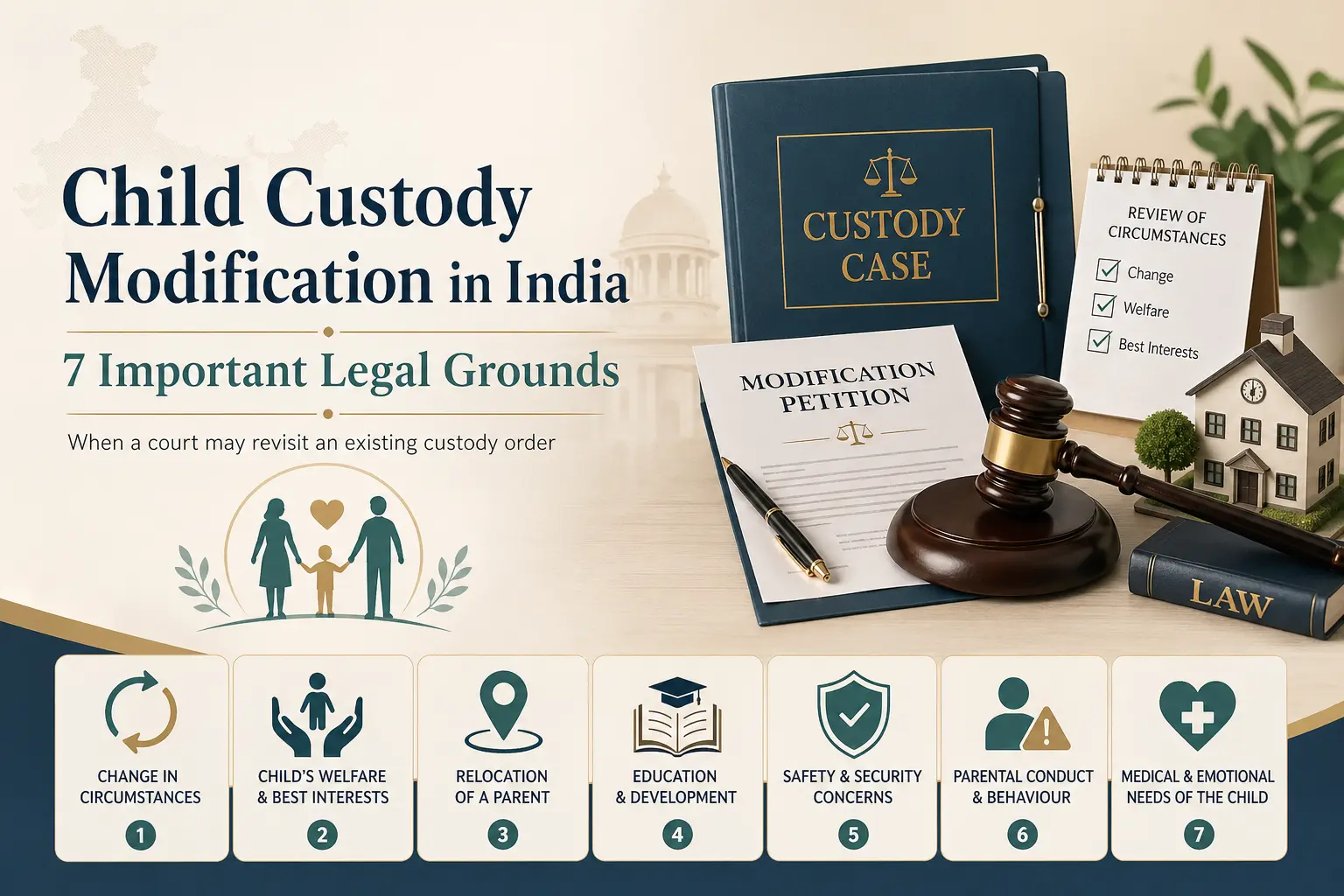
A child custody order is not always the final word. Life changes. A child grows older, schools change, one parent may relocate, a parent may remarry, or the existing arrangement may start harming the child’s emotional routine. That is where child custody modification in India becomes a serious legal option. Many parents in Delhi NCR and across India come to a lawyer only after the situation has already become painful. One parent stops visitation. The other parent shifts the child to another city without proper discussion. Sometimes a child refuses to meet a parent because the relationship has been damaged for months. In other cases, the parent who earlier looked stable is no longer able to provide safe care. Family Courts do not modify child custody orders merely because one parent is unhappy. The real question is different. Has something changed in a way that affects the child’s welfare? That single point controls most custody modification cases. For parents dealing with child custody change after divorce, visitation problems, remarriage, relocation, schooling disputes, or safety concerns, proper legal advice can prevent emotional decisions from becoming courtroom weaknesses. Advocate BK Singh assists parents in child custody and visitation matters with a welfare-focused, legally restrained approach. This guide explains the legal grounds for child custody modification, the Family Court route, the evidence usually required, the mistakes parents should avoid, and when a custody modification petition in India may become necessary. Custody disputes have become more complex in 2026 because family life has changed. Parents work in different cities. Children study in schools across Delhi, Noida, Gurugram, Ghaziabad, Faridabad, Lucknow, Mumbai, Bengaluru, Pune and Hyderabad. Many parents live in nuclear families without grandparents or extended support. Online schooling records, WhatsApp chats, call logs, travel documents and counselling notes now become part of custody disputes. A custody order passed two years ago may not suit the child’s present life. A toddler’s needs are not the same as a teenager’s. A child living in Delhi may suddenly face relocation to another state. A parent who earlier had time may now travel heavily for work. Another parent may have remarried and created a new household environment. Courts in India generally treat child custody as a welfare issue, not as a reward or punishment for either parent. The Hindu Minority and Guardianship Act, 1956 says the welfare of the minor is the paramount consideration while appointing or declaring a guardian. The Guardians and Wards Act, 1890 also requires the court to look at the welfare of the minor while passing guardianship orders. Delhi NCR matters need special care because parents often live across district and state borders. One parent may be in Dwarka, Rohini, Karkardooma or Tis Hazari jurisdiction while the other may be in Noida, Ghaziabad or Gurugram. School location, ordinary residence of the child, existing court order and pending matrimonial case can all affect the legal route. Parents looking for a wider background on custody principles can also read this detailed guide on child custody laws in India. Child custody modification means asking the competent court to change an existing custody, visitation, access or guardianship arrangement because later circumstances affect the child’s welfare. It is not a fresh fight over ego. It is a request to update the arrangement in the child’s best interests. Many people confuse custody modification with appeal. They are different. An appeal usually challenges the correctness of an earlier order. A modification request may accept that the earlier order was workable at that time, but argues that later events now require a different arrangement. That distinction matters because courts do not reopen old battles lightly. A parent may seek modification of custody order after divorce, during a pending matrimonial case, after relocation, after remarriage, after repeated visitation denial, or after a serious change in the child’s schooling, health or emotional condition. Courts often look at the child’s comfort, stability, safety, education, health, emotional bonding and routine. A parent’s legal right is relevant, but it does not automatically override the child’s welfare. Indian custody law does not work through one single statute for every family. The applicable law may depend on religion, marriage law, the pending case and the relief asked for. Still, the welfare of the child remains the guiding thread. Under Section 26 of the Hindu Marriage Act, 1955, in proceedings under that Act, the court can pass interim and final orders relating to custody, maintenance and education of minor children. The provision also allows the court to revoke, suspend or vary earlier orders relating to custody, maintenance and education. The Guardians and Wards Act, 1890 is a key statute for guardianship and custody related proceedings. Section 7 permits the court to appoint or declare a guardian when it is satisfied that such an order is for the welfare of the minor. Section 9 connects jurisdiction with the place where the minor ordinarily resides. The Hindu Minority and Guardianship Act, 1956 makes the welfare of the Hindu minor the paramount consideration and says no person is entitled to guardianship if the court believes that guardianship will not be for the welfare of the minor. The Family Courts Act, 1984 gives Family Courts jurisdiction over suits and proceedings relating to guardianship, custody and access to any minor. It also encourages settlement efforts where suitable and allows the Family Court to use a procedure aimed at reaching truth and settlement in family disputes. Recent Supreme Court reasoning also confirms that custody orders are not rigid and final forever. Courts may alter custody arrangements when the best interests of the minor require it, especially where changed circumstances affect the quality of the child’s upbringing. For parents already involved in divorce litigation, this background often connects with the wider matrimonial process explained in this guide on how to file a divorce petition in Delhi Family Court. This guidance is useful for parents who already have a custody or visitation order and now feel that the arrangement no longer protects the child’s welfare. It may also help grandparents, guardians and relatives who are involved in caregiving, though they should seek case-specific legal advice before taking any step. A mother may need modification if the father repeatedly violates visitation boundaries or tries to remove the child from school without consent. A father may need modification if he is being completely denied access despite a court order. A working parent may need revised visitation because school timings, travel time and work hours have changed. NRI parents, inter-city families and parents living across Delhi NCR face another practical difficulty. A child may be studying in Noida while one parent works in Gurugram and the other lives in East Delhi. A rigid order can become unworkable. Courts do understand practical realities, but the parent must present them responsibly. The guidance also applies to parents dealing with child custody modification due to child welfare concerns such as emotional distress, neglect, unsafe living environment, unstable schooling, medical needs, substance abuse concerns, or repeated obstruction of the child’s bond with the other parent. For a broader service view, parents can explore child custody and visitation rights case filing in Delhi. A Family Court usually looks for a material change in circumstances. The change must be real, relevant and connected with the child’s welfare. Small inconvenience is usually not enough. The strongest ground for child custody modification in India is a clear change affecting the child’s welfare. Welfare includes physical care, emotional stability, schooling, health, safety, moral environment and overall development. For example, if a child’s school attendance has dropped after custody was given to one parent, the other parent may raise concern. If the child is showing anxiety, fear, withdrawal or sudden academic decline, the court may examine whether the current arrangement needs correction. A child’s welfare is wider than money. A parent with a high salary does not automatically become the better custodian. Courts often examine daily involvement, emotional availability, routine, discipline, school support and the child’s comfort. Custody modification may be sought when the custodial environment becomes unsafe or neglectful. This may include lack of supervision, exposure to violence, addiction-related concerns, repeated verbal abuse, poor medical care or leaving the child with unsuitable persons for long periods. Such allegations need evidence. Courts do not act on anger alone. A parent should preserve school records, medical papers, messages, photographs, complaints, counselling notes and credible witness details. If domestic violence or safety concerns are involved, related proceedings under the Domestic Violence Act may also influence the court’s understanding of the family environment. Readers may refer to the service page on domestic violence cases under the DV Act for connected reliefs. Custody modification after relocation is common in Delhi NCR. A parent may shift from Delhi to Bengaluru, Mumbai, Pune, Chandigarh or abroad. Sometimes relocation is genuine because of employment. Sometimes it is used to reduce the other parent’s access. Courts generally do not stop every relocation. They examine whether the move benefits the child, whether schooling remains stable, whether the other parent’s visitation can continue, and whether the relocating parent acted transparently. A unilateral move without notice can damage a parent’s credibility. A planned relocation with school details, residential arrangement, travel access and communication schedule stands on stronger footing. Custody modification after remarriage is not automatic. A parent’s remarriage alone does not prove unfitness. The court looks at the child’s actual comfort in the new household. Problems may arise if the child is neglected after remarriage, faces hostility from a step-parent, loses personal space, or shows emotional distress. On the other side, remarriage may also create a more stable household if the child receives better care and support. Family Courts avoid moral judgment. They ask a practical question. Does the new household arrangement help or harm the child? Visitation rights modification in India may become necessary when one parent repeatedly blocks court-ordered access. Missed calls, cancelled meetings, refusal to share school updates and negative conditioning of the child can gradually damage the parent-child bond. Not every missed visit becomes contempt or modification ground. Illness, exams, travel and genuine emergencies happen. A pattern is different. If a parent consistently prevents access, the court may revise visitation, create a structured schedule, allow video calls, direct neutral handovers, or in serious cases reconsider custody. The focus remains the child’s emotional balance, not punishment. For contested access disputes, this page on child custody and visitation rights appeal and revision in Delhi may help readers understand available legal routes. A child’s preference can matter when the child is old enough to form an intelligent view. Courts may interact with the child in a sensitive manner, especially in contested custody cases. The child’s wish is not the only factor. A child may be influenced, pressured or emotionally confused. Still, a mature and consistent preference can carry weight where it aligns with the child’s welfare. Parents should never coach a child to speak against the other parent. Judges often sense coaching. More importantly, it harms the child. A parent’s health condition, financial instability, heavy travel, job loss, new work schedule or inability to supervise the child may become relevant. A child’s own medical, educational or special needs may also justify modification. For instance, a child with therapy needs may require the parent who can attend appointments regularly. A board-exam student may need a calmer home. A young child may need predictable caregiving rather than frequent city-to-city movement. Financial capacity is relevant, but it does not decide custody by itself. Courts weigh care, time, stability and emotional security along with resources. The process starts with a careful review of the existing order. A parent should not rush to file without understanding what the order actually says. Many custody orders contain detailed access schedules, holiday arrangements, communication rules and handover conditions. After that, the lawyer studies later developments. What changed after the order? Did relocation happen? Were visits denied? Did the child’s health suffer? Are school records showing concern? Has the child expressed discomfort? Is there any police complaint, domestic violence proceeding, maintenance dispute or guardianship issue connected with the matter? A properly drafted custody modification petition in India should explain the earlier order, the changed facts, the child welfare concern and the relief requested. Relief may include change of physical custody, revised visitation, supervised visitation, holiday access, video calling, school information sharing, travel restrictions, or directions for counselling. The court may issue notice to the other parent. Depending on urgency, interim relief may be sought. Family Courts may also encourage mediation where appropriate. Mediation can work where both parents are willing to create a child-focused arrangement. It usually fails where one parent uses delay, pressure or emotional blackmail. Evidence then becomes important. Courts may consider affidavits, school records, medical papers, messages, photographs, travel records and other documents. In suitable cases, the court may interact with the child or seek assistance from counsellors or welfare experts. Parents involved in settlement discussions can also review the service page on mediation and settlement, especially where custody and visitation can be structured without unnecessary bitterness. Documentation can decide the strength of a custody modification case. A sincere parent with weak records may struggle. A calm parent with proper documents usually appears more credible. Parents should avoid editing chats, hiding context or presenting selective screenshots. Courts prefer clean, complete and verifiable records. A lawyer may also help identify which documents support custody and which documents may create avoidable complications. For cases connected with guardianship or permission issues, this service page on guardianship and minor permission matters may be relevant. Custody matters can move fast when the child faces immediate risk. Routine modification cases may take longer because courts need to hear both sides and examine the child’s welfare carefully. A parent should not wait endlessly if the other parent is violating access orders. Delay can create a new routine around the child, and courts may hesitate to disturb a settled routine unless welfare requires it. That is why early legal action matters. Interim applications may be filed where urgent access, school continuity, travel restraint or safety direction is needed. Final custody modification takes more detailed examination. The timeline varies by court, urgency, evidence, cooperation of parties and whether mediation works. No lawyer can honestly promise a fixed disposal date or guaranteed result. Family Court outcomes depend heavily on facts, documents and the child’s welfare. For Delhi High Court connected matrimonial matters, readers may also see divorce lawyer in Delhi High Court, especially where custody issues overlap with appellate or writ-related concerns. Many parents damage their own case before filing. Anger makes them act quickly, but custody cases reward restraint. A custody modification petition should not read like a complaint about a failed marriage. Courts want to know how the child is affected. Personal allegations matter only when they connect with welfare. A parent may feel justified in stopping access, but self-help can backfire. Unless there is immediate safety risk, seek legal directions instead of creating unilateral barriers. Telling a child what to say creates emotional pressure. Courts dislike it. Children deserve protection from litigation language. A petition full of allegations but without documents often appears weak. Keep records before making serious claims. Some parents do not read the order properly. They violate it unknowingly, then blame the other side. Read every line. Maintenance disputes and custody concerns can overlap, but they should not be confused. A parent cannot use the child as pressure for money. Public posts about custody fights can hurt the child and the parent’s credibility. Courts expect maturity. A parent planning to move should handle it transparently. Sudden relocation can look like an attempt to cut off the other parent. Some cases need firm litigation. Others can be solved through structured access terms. Rejecting every discussion may not help. Early legal advice can prevent long-term emotional damage. Waiting for months may make the issue harder to correct. Ignoring a failing custody arrangement rarely protects the child. Silence often allows the problem to grow. A child may lose emotional connection with one parent. School performance may drop. Medical needs may be missed. The child may develop fear, confusion or loyalty conflict. In severe cases, one parent may relocate without proper consent, making access harder. Legal risks also increase. If a parent does not act after repeated violations, the other side may argue that the arrangement was accepted. Delay is not always fatal, but it can weaken urgency. Financial and practical consequences follow too. Emergency litigation is more stressful and often more expensive than planned legal action. Parents who act calmly and early usually create a cleaner record. A parent should consult a child custody modification lawyer when the existing order no longer works for the child, when access is repeatedly denied, when relocation is being planned, or when the child’s health, schooling or safety is affected. Legal advice is also necessary before changing the child’s school, moving the child to another city, stopping visitation, filing a police complaint, or sending aggressive messages to the other parent. Delhi NCR custody matters can involve multiple courts and jurisdictions. A parent in Noida may need to respond to proceedings in Delhi. A parent in Gurugram may have a child studying in South Delhi. A Ghaziabad residence may raise different practical questions. Proper legal planning avoids confusion. If the dispute has already reached a contested stage, the page on contested divorce and litigation may help readers understand how matrimonial litigation connects with custody reliefs. divorcelawyerdelhincr.com assists parents in custody, visitation, guardianship, divorce and family litigation matters with a child-welfare focused approach. The aim is not to inflame family conflict. The aim is to present facts clearly, protect the child’s interest, and seek practical relief through the correct legal route. Advocate BK Singh can assist with reviewing existing custody orders, drafting custody modification petitions, preparing evidence, handling visitation disputes, advising on relocation issues, and representing parents before the appropriate Family Court or higher court where required. The service is especially useful for parents in Delhi, New Delhi, Noida, Greater Noida, Ghaziabad, Gurugram, Faridabad and other high-demand regions where inter-city parenting disputes are common. For a full practice overview, readers may visit the website’s legal services page. Yes. A child custody order can be modified if later circumstances show that a change is necessary for the child’s welfare. Courts do not modify orders casually. The parent seeking change must show a genuine welfare-related reason. The main ground is the welfare of the child. Courts examine safety, education, health, emotional comfort, stability, parent-child bonding and overall development. Parental preference alone is not enough. Yes. Child custody change after divorce is possible if circumstances materially change after the decree or custody order. For example, relocation, neglect, repeated denial of visitation or child welfare concerns may justify modification. Yes. Father child custody rights in India are recognised, but the father must show that the requested change serves the child’s welfare. Courts do not decide custody only by gender. Yes. Mother child custody rights in India include the right to oppose a modification request if the proposed change harms the child’s welfare or lacks proper basis. Remarriage alone does not automatically change custody. Custody modification after remarriage depends on how the new household affects the child’s welfare, comfort, safety and emotional development. Yes. Custody modification after relocation may be considered if the move disrupts schooling, stability or meaningful contact with the other parent. Courts examine the reason for relocation and the plan for continued access. Yes. Visitation rights modification in India can be sought even where physical custody remains with the same parent. Courts may change meeting schedules, holiday access, video calls or handover arrangements. The court may consider the child’s preference if the child is mature enough to express an intelligent view. The child’s wish is relevant, but it does not override welfare. A lawyer is strongly advisable because custody modification involves pleadings, evidence, welfare grounds, jurisdiction and interim relief. A poorly drafted petition can weaken even a genuine case. Child custody modification in India is not about winning against the other parent. It is about protecting the child when an old arrangement no longer works. A parent who acts early, preserves evidence and keeps the child’s welfare at the centre usually stands on firmer ground. Courts look for maturity. They also look for facts. If your existing custody or visitation arrangement is affecting your child’s routine, schooling, safety or emotional health, speak to a child custody modification lawyer before taking any drastic step. Advocate BK Singh and divorcelawyerdelhincr.com can help assess the order, identify the correct legal route and prepare a welfare-focused response. This article is for general legal information only and should not be treated as legal advice for any specific case.Child Custody Modification in India: 7 Important Legal Grounds
Why Child Custody Modification Matters in India, Delhi NCR and Other Cities in 2026
Quick Facts Box
Understanding the Core Legal Issue
The Legal Framework for Child Custody Order Modification in India
Who Needs This Guidance?
What Are the 7 Important Legal Grounds for Child Custody Modification in India?
1. Serious Change in the Child’s Welfare
2. Neglect, Unsafe Environment or Harmful Conduct
3. Relocation That Disrupts Schooling or Parent-Child Contact
4. Remarriage or Major Change in Household Circumstances
5. Repeated Denial of Visitation or Parental Alienation Concerns
6. Mature Preference of the Child
7. Change in Health, Education, Financial Care or Daily Availability
How Does the Custody Modification Process Usually Move?
Broad Custody Modification Route
Documents and Evidence Checklist for Custody Modification
Category Useful Documents Existing court record Custody order, visitation order, divorce decree, interim applications, mediation settlement Child welfare record School report cards, attendance records, teacher notes, medical reports, counselling records Communication proof WhatsApp chats, emails, call logs, access denial messages, travel updates Relocation proof New address, job transfer letter, school admission details, travel schedule Safety concerns Complaints, medical documents, photographs, witness details, protection order papers Parenting involvement Fee receipts, medical appointment records, school meeting proof, activity records Financial and care capacity Income proof, residence proof, work schedule, caregiving support details What Timelines, Delays and Decision Windows Should Parents Know?
Common Mistakes Parents Make in Child Custody Change After Divorce
1. Treating Custody as Revenge
2. Stopping Visitation Without Legal Permission
3. Coaching the Child
4. Filing Without Evidence
5. Ignoring the Existing Order
6. Mixing Maintenance Anger With Custody
7. Making Social Media Posts
8. Hiding Relocation Plans
9. Ignoring Mediation Opportunities
10. Waiting Until the Child Suffers Too Much
Risks of Ignoring a Bad Custody Arrangement
When Should You Consult a Child Custody Modification Lawyer?
How divorcelawyerdelhincr.com Can Help
Frequently Asked Questions
1. Can a child custody order be modified in India?
2. What is the main ground for child custody modification in India?
3. Can custody be changed after divorce?
4. Can a father seek custody modification in India?
5. Can a mother oppose custody modification?
6. Does remarriage affect child custody?
7. Can relocation be a ground for custody modification?
8. Can visitation rights be modified separately?
9. Will the court ask the child’s preference?
10. Do I need a lawyer for custody modification petition in India?
Final Thoughts
Disclaimer
Don't worry; Divorce Lawyer Delhi NCR explains everything in plain language without using legal jargon.
No stress and no confusing legal language, Divorce Lawyer Delhi NCR gives clear, honest guidance based on real case experience so the divorce process stays simple and easy to understand.
Schedule Your Consultation