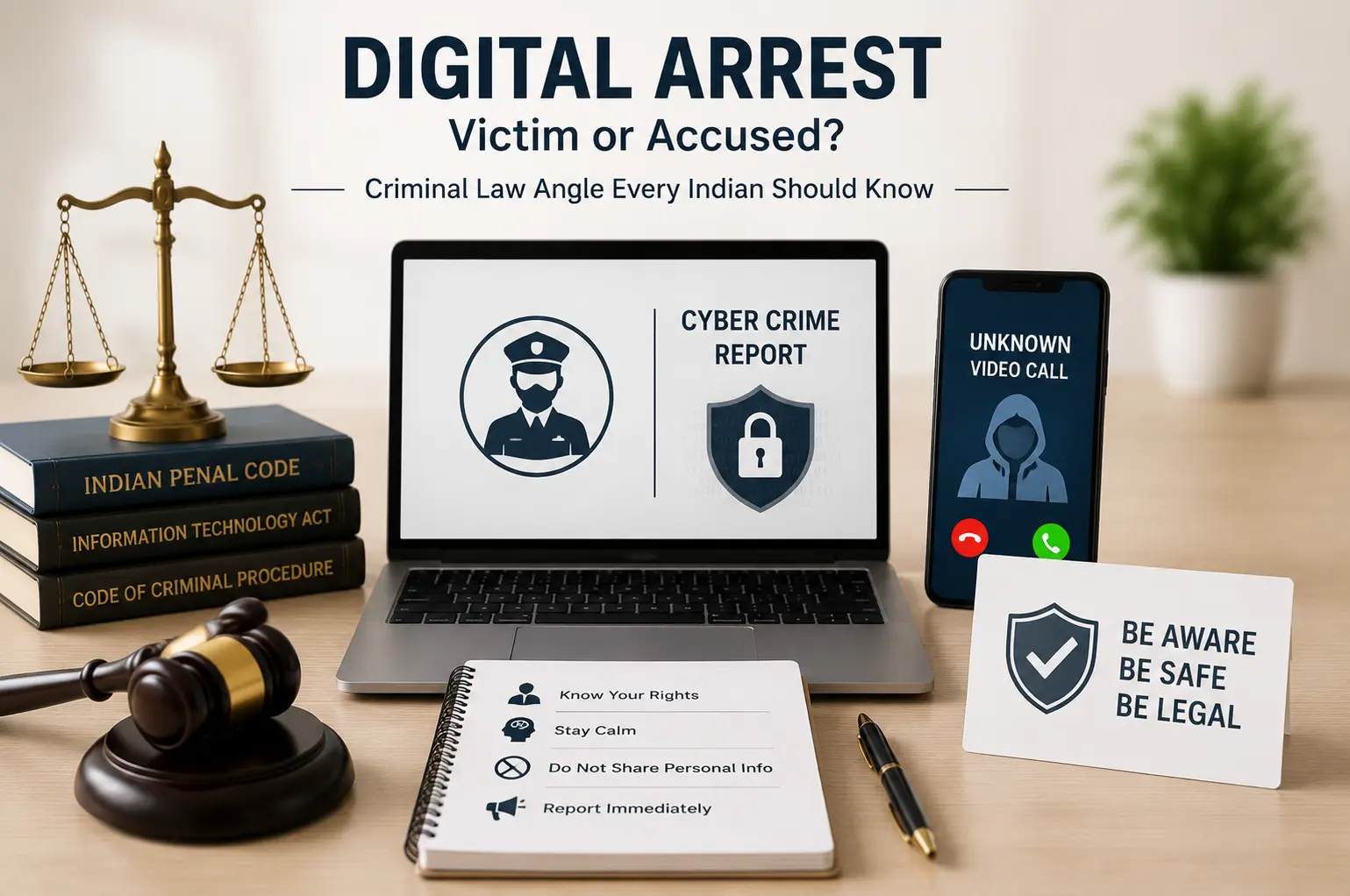
Starts a video call. The caller claims to be from CBI, Delhi Police, Mumbai Cyber Cell, Customs, ED, Narcotics or a “court department”. Your Aadhaar, mobile number or bank account are said to be linked to drugs, money laundering, illegal parcels or terror funding. Then there’s the line that breaks people emotionally: “You are under digital arrest. Don’t put down the phone. That sentence has scared students, senior citizens, working professionals, business owners and parents across India. Some people lose their money. Some send papers. Some share OTPs. Later, some are pulled into investigation as their bank account, SIM card, UPI ID or company account is found in the money trail. This is why Digital Arrest Victim or Accused is not a cyber awareness topic anymore. It has become a significant criminal law issue. With a digital arrest, a scammer informs the victim that they have been virtually arrested, either by a video call or online communication. There is no such method of arrest in Indian law. Real arrest, summons, notice, search, seizure and investigation is law and not WhatsApp video threats. The Indian Cyber Crime Coordination Centre has clarified publicly that no agency including the police, CBI, ED, Customs and judges can arrest a person through video call. For victims the key question is how to report quickly, freeze the money trail and preserve evidence.” For accused persons especially mule account holders, SIM users, employees, agents or people wrongly linked with cyber fraud, the concern is different. How to respond to police notice, freezing of bank account, FIR sections, arrest risk and electronic evidence. Advocate BK Singh explains such matters in one simple way. Panic helps the fraudster, but documentation helps the case. The sooner you can go from fear to record-building the better your legal position. Digital arrest scams are on the rise because they prey on fear, technology and confusion about how the law works. Now in Delhi, New Delhi, Ghaziabad, Noida, Greater Noida, Gurugram, Faridabad, Meerut, Hapur, Lucknow, Kanpur, Prayagraj, Varanasi, Agra, Jaipur, Chandigarh, Mumbai, Pune, Bengaluru, Hyderabad, Chennai, Kolkata and Ahmedabad, people get scam calls from numbers that look official, even police-style display photos, fake ID cards, fake notices and scripted video-call pressure. The bigger risk is not just losing money. A victim could lose years of savings in a matter of hours. The caller mentions narcotics and a student may panic. A business owner can transfer money out of a company account. A senior citizen can be threatened with arrest of his/her family members. A working professional may have to keep the video call open through the night. The objective of the fraudster is often to isolate the person from family, bank staff, police and lawyers. The practical problem in cities like Delhi NCR is The victim can be from Noida, have a bank account in Delhi, be called from a virtual number, transfer money to accounts in Rajasthan or West Bengal and later be told that the complaint has been marked to some other state police unit. Cyberfraud crosses jurisdictions. What makes it matter is proper complaint drafting, transaction details, bank coordination and follow up with the cyber police. As to the accused’s side, the problem is equally serious. That a small part of the fraud money came into his account . Police may call a person because of this . “This could be a case where a student may have rented out his bank account for ‘commission’ without realising that it is an offence. Shopkeepers may have sold SIM cards without verifying properly. A fintech employee may be asked about KYC, wallet movement or gateway records. Sometimes innocent people are also dragged into investigation because their account was misused or hacked. The Supreme Court’s concern over digital arrest scams, as well as reports of a pan-India probe, show how seriously law enforcement is taking this pattern. News reports in December 2025 said the Supreme Court ordered a unified CBI-led probe into digital arrest scam cases, pointing to the nationwide scale of the problem. The message to ordinary Indians is clear. Digital arrest is a lie, but the legal ramifications of it are very real. In India, digital arrest is not a legal form of arrest. No policeman, CBI officer, ED officer, Customs officer or judge can have the power to arrest you legally through a video call alone. Victims should report cyber financial fraud immediately on 1930 and the National Cyber Crime Reporting Portal. The official portal itself recommends reporting immediately through cybercrime.gov.in or 1930. Common sections under the law are cheating, cheating by personation, extortion, personating a public servant, forgery, using forged electronic records, criminal intimidation and IT Act offences. Accused persons should not ignore BNSS notice, police call, account freeze communication or cyber cell summons. Screenshots, call recordings, transaction ids, bank statements and complaint acknowledgements should be preserved as they can make or mar the case. Your legal strategy will depend on whether you are a victim, witness, account holder, intermediary employee, alleged caller, beneficiary, agent or wrongly implicated person. The crux of the matter in Digital Arrest Victim or Accused is deception with false authority. The fraudster uses the fear of law to make the victim comply with illegal directions. Criminal law investigates what exactly happened: impersonation, threat, dishonest inducement, transfer of money, forged electronic documents, use of fake identity, conspiracy, bank account layering and destruction of digital evidence. There are legal signs of a real criminal trial. Notice for appearance may be issued by police. A summons could come through legal channels. Investigation may include written complaint, FIR, statement, seizure memo, notice, arrest memo, remand, bail hearing or court order. A fraudster, on the other hand, pressures the victim to stay on video call, not talk to family, not approach police, not consult a lawyer and to transfer money for “verification”, “safe custody”, “bail”, “RBI audit” or “case closure”. That counts. The victim must prove that money was passed due to dishonest inducement, fear, impersonation or threat. The accused must prove his real role, absence of dishonest intention, lack of knowledge, explanation of legitimate transaction, KYC trail, account control history and cooperation with investigation. Many people get this wrong, because they only see a digital arrest case as “online fraud”. This is far too narrow. This may include cyber crime, criminal conspiracy, forged documents, bank freezing orders, telecom data, device forensics, money trail, risk of custodial interrogation and bail strategy. Senior citizen who lost money needs a way to recover and a route for complaint. A young account holder whose account has received funds may need immediate criminal defence advice. Usually, the first thing advocate BK Singh tells clients is to find out what they did in the case. Are you a complainant, victim, witness, account holder, payment receiver, accused, company officer, family member or intermediary? That one answer changes the whole legal plan. Digital arrest cases in India are generally booked under the Bharatiya Nyaya Sanhita, 2023, Bharatiya Nagarik Suraksha Sanhita, 2023, Bharatiya Sakshya Adhiniyam, 2023 and the Information Technology Act, 2000. The specific provisions depend on facts. No lawyer should type out sections without checking the complaint, transaction trail and evidence, blindly. The Bharatiya Nyaya Sanhita, 2023 has many offences that could be applicable to digital arrest scams. BNS Section 308 is extortion, Section 318 is cheating and Section 319 is cheating by personation under India Code. Often relevant where fraudsters frighten victims and dishonestly induce them to transfer money. Section 204 of the BNS relates to impersonation of public servant. That is where it matters, especially when a fraudster impersonates a police officer, CBI officer, ED officer, Customs officer, court officer or any government authority. Section 204 is listed as “Personating a public servant” in India Code. C. Other Provisions That May Be Relevant in Connection With Forgery Digital arrest gangs usually circulate fake arrest warrants, forged notices, fake court orders, police ID cards, fake FIR extracts, fake seals and screenshots which look official. The India Code lists provisions of the BNS such as making a false document, forgery and using a forged document or electronic record as genuine under Sections 335, 336 and 340 respectively. Criminal intimidation may also be applicable if threats are made to arrest, defame, harm family members, freeze accounts, publish false allegations or raid homes. Large networks may raise questions of conspiracy, abetment and organised crime but that depends on the material of investigation and should not be casually assumed. The Information Technology Act, 2000 comes into play as digital arrest scams generally involve phones, messaging apps, video calls, fake links, computer resources, remote-access applications, digital documents, electronic wallets, UPI, bank accounts and online identity misuse. Section 66D is specifically related to cheating by personation by means of a computer resource or communication device. Section 66D of India Code, is punishment for cheating by personation by using computer resource. Section 66C could be a factor in identity theft cases. Section 66 can be invoked for unauthorised access. Other provisions might apply, depending on the facts. But lawyers should not pad complaints with irrelevant sections. Overdrawing can erode credibility. BNSS regulates criminal proceedings. It deals with FIR, investigation, arrest, notice, search, seizure, remand, bail, trial and procedural steps connected therewith. Section 35 often comes into play in accused-side matters as it deals with the when the police may arrest without warrant and notice for appearance in appropriate cases. Section 35 of the India Code is headed “When police may arrest without warrant. “Notice of appearance is not an arrest. It can be a problem. Showing up unprepared for legal can also be problematic. The safer way is to review the notice, understand the alleged transaction, gather documents, prepare a factual explanation and cooperate through lawful procedure. Cases of digital arrest are heavily reliant on electronic evidence. Screenshots, call records, bank messages, UPI IDs, WhatsApp chats, Telegram messages, IP logs, device details, email headers and transaction records need to be preserved properly. A screenshot out of context may not be enough. Courts and investigators want to see things like reliability, chain of custody, device source, metadata when available and supporting bank records. The victim’s case is about immediate reporting, freezing the money trail, preservation of evidence, clarity of complaint and follow-up. The accused-side case is all about role, intention, knowledge, account control, device control, transaction explanation, summons compliance, bail risk and defence documents. Digital arrest guidance not only for victims who lost money. It’s also for anyone whose name, bank account, mobile number, device, business account, payment gateway, employee ID or documents are in cybercrime trail. Delhi senior citizen duped in fake CBI video call, needs quick action to transfer savings. Noida student wants defence advice after friend uses his account to get ‘commission’ A trader in Ghaziabad needs documents after his current account was frozen following a suspicious transaction. Gurugram Startup Founder Whose Payment Gateway Is Under Police Scanner Needs To Respond In A Measured Manner If you are a parent in Lucknow and have received a BNSS notice for your child, don’t treat it as a routine police call. Business owners need this guidance too, as company bank accounts, employee reimbursement accounts, payment links and online merchant IDs can be exploited. Startups, fintech-related vendors, e-commerce merchants and service providers often handle digital payments frequently. If the fraud money sits in the account even for a short time, investigation may follow. This is information parents need for another reason. Many young people unwittingly share accounts, sell SIM cards, take part-time “payment handling” work, lend debit cards or take money for strangers. Later they would say they did not know. Ignorance is a defence in some fact situations but it has to be supported by records, messages and conduct. Embarrassment causes delay and such notices should not be hidden from lawyers, advocate BK Singh told families. In cybercrime, an early explanation is often better than a late defense. First, a digital arrest victim needs to break the scammer’s control, preserve all evidence, report immediately, inform the bank and create a clean legal trail. The first hours are crucial as money can be laundered through several bank accounts, wallets and crypto or cash-out channels. Delay reduces the risk of freezing the funds. First end the call; Don’t engage with the scammer. Don't "try" him. Do not share your Aadhaar, PAN, OTP, card details, screen access, passwords, banking PINs or family information. If the caller claims that a parcel, SIM card, bank account or Aadhaar is linked to crime, tell him you will verify through the nearest police station. Real officers don’t need you to stay alone on video call. Second, inform one trusted family member immediately. Digital arrest scams work because the victim is isolated. Fraudsters say that speaking to anyone will lead to arrest. That is false. A quick family intervention can stop payment. Third, call 1930 if any money has been transferred or if financial fraud has occurred. Then file a complaint on the National Cyber Crime Reporting Portal. The official cybercrime portal itself asks victims to report immediately through cybercrime.gov.in or 1930. Fourth, inform your bank through the official fraud reporting channel. Give transaction ID, date, time, amount, beneficiary account, UPI ID, IMPS or NEFT reference, screenshots and complaint acknowledgement. Ask the bank to mark the transaction as disputed and take urgent action as per cyber fraud procedure. Fifth, file or pursue a proper police complaint or FIR route. Depending on the facts, the matter may be handled by the local police station, cyber police station, district cyber cell or specialised cybercrime unit. In Delhi NCR, the practical forum may differ depending on residence, place of banking, place of occurrence and cyber cell practice. A properly drafted complaint should explain the sequence, deception, threat, transfer, evidence and relief requested. Sixth, keep all devices intact. Do not delete WhatsApp chats, Telegram chats, SMS, call logs, emails, screenshots or payment messages. Do not format the phone. Do not uninstall apps used in the scam unless advised after preserving evidence. Seventh, prepare a compact written chronology. The first call was received, the identity was presented, the threat was made, the documents were displayed, the amount of money was transferred, the money was transferred to what accounts and when the complaints were lodged. A person confused between FIR, police complaint and Magistrate route can read this internal guide on criminal complaint, FIR or Magistrate case for broader procedural understanding. Use that only as general guidance; cyber fraud facts still need case-specific review. A person named or suspected in a digital arrest scam should not panic, abscond, delete data, ignore police communication or give an emotional statement without preparation. The first task is to understand the exact allegation and your link with the transaction, SIM, device, document, account or person under investigation. Start by identifying how you came into the case. Did your bank account receive money? Did you open an account for someone else? Did a friend use your UPI ID? Did you sell or lend your SIM card? Did you work in a call centre? Did you create documents, websites, WhatsApp groups or payment links? Did your company process the payment? Did police freeze your account because another state complaint named your account? Next, gather your documents before leaving. Bank statements, account opening form, KYC records, employment proof, chat history, transaction explanation, invoices, customer records, device ownership proof, SIM purchase details and any complaint made by you can help. A person who can explain the transaction calmly stands in a better position than a person who arrives empty-handed. If you receive a BNSS notice, do not ignore it. A notice may require appearance, documents or explanation. Non-compliance can make the matter worse. At the same time, appearing without legal review can lead to careless admissions. Advocate BK Singh normally recommends a careful pre-appearance consultation where facts are organised and documents are checked. Do not delete chats or change phones. Deleting electronic evidence can create suspicion. If you have innocent messages proving that someone misled you, preserve them. If you received a job offer to “process payments”, preserve the offer letter, Telegram messages, commission promise and any identity details of the recruiter. If you fear arrest, get legal advice on anticipatory bail or protective relief where legally maintainable. Not every cyber notice requires bail. Not every cyber case permits a relaxed approach. The section, role, amount, cooperation, location and police conduct all matter. For families in Delhi NCR, Noida, Gurugram, Faridabad, Ghaziabad and nearby districts, physical distance between police stations can become stressful. Notices may come from another state. In such cases, legal coordination, representation and communication with the investigating officer must be done carefully and respectfully. Evidence decides the strength of digital arrest cases. A victim’s documents prove deception and money flow. An accused person’s documents prove role, intention, knowledge and legitimate explanation. Do not wait for police to ask for every paper. Build the file early. For victims, preserve the caller’s number, WhatsApp profile, Telegram ID, Skype ID, email ID, screenshots of video call, fake ID card, fake warrant, fake court order, fake police notice, bank transfer proof, UPI reference number, IMPS or NEFT details, debit messages, cyber portal acknowledgement, 1930 complaint reference, bank complaint number and any call recordings. Also preserve your written recollection. Many victims forget details after the panic settles. Write down the exact words used by the fraudster: drugs parcel, money laundering, Aadhaar misuse, narcotics, CBI case, ED file, arrest warrant, Supreme Court order, police verification, RBI audit or account verification. These phrases show the pressure method. For accused-side matters, keep bank statements for the relevant period, source-of-funds proof, invoices, salary slips, loan documents, business ledger, wallet records, KYC documents, account opening documents, device purchase bill, SIM ownership proof, messages with the person who asked for account use, employment records and any prior complaint showing misuse. Company-side records may include internal emails, compliance logs, KYC documents, customer onboarding data, payment gateway records, merchant agreements, IP logs, access controls, employee duty charts and audit trails. A company should avoid sending scattered screenshots without legal review. A clean compilation is easier for police and safer for the company. One more point. If money has been credited into your account without your knowledge, do not withdraw or transfer it casually. Inform your bank and take legal advice. Moving suspicious money after knowledge can create a stronger allegation of involvement. Digital arrest cases punish delay. Victims should treat the first few hours as a legal emergency because money can be layered through multiple accounts. The faster the complaint reaches 1930, the cyber portal and the bank, the better the possibility of freezing funds in the trail. No lawyer can promise recovery, but late reporting clearly reduces practical chances. Police investigation may take time because the money trail may involve several bank accounts across states. A Delhi victim may find beneficiary accounts in Rajasthan, West Bengal, Tamil Nadu or Telangana. A Mumbai or Pune victim may see money pass through accounts opened with fake or rented KYC. A Noida business account may be frozen because a complaint from another state reported a transaction chain. For victims, the decision window is immediate. Report, preserve evidence, file complaint, coordinate with bank, follow up with cyber cell and prepare a detailed complaint. Waiting for the fraudster to “return money after verification” is dangerous. They rarely stop after one transfer. For accused persons, the decision window starts from the first police call, notice, bank freeze, summons or visit. A person who receives a notice and waits for weeks may lose the opportunity to place a clean explanation early. A person who sends an unverified written reply may create contradictions. A person who absconds may increase arrest risk. Bank account freeze matters also need attention. If your account is frozen because of a cyber complaint, ask the bank for details of the freeze communication to the extent they can share. Then approach the concerned police authority with documents showing legitimate source and limited role. Court remedy may be considered where freezing is excessive, prolonged or unsupported, but the facts must justify it. Advocate BK Singh generally tells clients that cybercrime matters need two calendars: the legal calendar and the practical calendar. The legal calendar tracks notice, FIR, bail, complaint and court dates. The practical calendar tracks bank response, cyber portal status, IO follow-up, document collection and account freeze impact. For a victim, ignoring the matter can mean permanent loss of money, repeated blackmail, identity misuse and weak investigation record. Fraudsters may use the victim’s Aadhaar, PAN, photograph, signature, bank details or video recording to create further threats. Some victims receive follow-up calls from fake “cyber recovery agents” who promise refund for a fee. Financially, delay can reduce the chance of freezing funds. Once money is withdrawn, converted, transferred or layered through multiple accounts, recovery becomes harder. The complaint may still proceed, but money recovery becomes uncertain. Emotionally, silence creates guilt. Many senior citizens and parents hide the incident because they feel embarrassed. Fraudsters rely on that shame. A clean complaint is better than private suffering. For accused-side persons, ignoring the matter can lead to arrest risk, coercive investigation steps, repeated police visits, account freeze continuation, travel disruption, employment concerns and court complications. If a person fails to comply with a lawful notice, police may treat the conduct as non-cooperation. For business owners, the risk includes blocked current accounts, vendor disputes, employee panic, customer refund issues and reputational harm. A company whose account is frozen cannot simply say “we are not involved” and wait. It must prepare records. For families, the long-term risk is confusion. Parents may not know whether their child is a witness, victim or accused. Early legal review prevents wrong assumptions. Advocate BK Singh has seen matters where a small delay changed the tone of police questioning because documents were not ready at the first stage. Consult a lawyer immediately if money has been transferred, forged legal documents were shown, the fraudster used your personal documents, your bank account has been frozen, police have called you, you have received a BNSS notice, your name appears in a cyber complaint, your SIM or UPI was used by someone else, or your company account received suspicious funds. Victims should consult a lawyer when the complaint is not being properly registered, the bank is not responding, the cyber portal complaint needs follow-up, large money is involved, elderly family members are affected, forged court or police documents were used, or there are threats of further exposure. Accused-side persons should consult before appearing before cyber cell if they do not understand the allegation. That does not mean avoiding police. It means preparing a truthful, organised and legally safe response. Students and young professionals need extra care. Many mule-account cases start with small payments, part-time job messages or “receive and forward money” instructions. A young person may not understand the seriousness until police arrive. At that point, family panic is natural, but panic should not decide strategy. Business owners should consult early if a current account freeze affects operations. A lawyer can help organise transaction records, communicate with police, evaluate court remedy and reduce avoidable escalation. Advocate BK Singh focuses on document-led advice in such matters because criminal law does not move on emotions alone. It moves on facts, records, intention, conduct, procedure and evidence. bksinghadvocate.com can assist in Digital Arrest Victim or Accused matters through consultation, complaint drafting, FIR route assessment, cyber cell representation, bank freeze response, accused-side notice handling, bail risk review and evidence organisation. The approach is practical: first identify the client’s role, then build the file, then choose the correct legal step. For victims, the assistance may include preparing a detailed cybercrime complaint, organising transaction evidence, drafting bank communication, advising on police follow-up and guiding the family on what not to destroy. For accused or suspected persons, the work may include reviewing police notice, preparing documents for appearance, assessing arrest risk, drafting representation, coordinating lawful cooperation and advising on bail or court remedy where needed. Advocate BK Singh does not treat every cyber matter the same way. A senior citizen who has lost savings needs a different response from a bank account holder whose account was used unknowingly. A business current-account freeze needs different handling from a student mule-account allegation. A forged court order needs stronger criminal complaint framing than a simple suspicious call. Clients can talk to a lawyer online for a structured first review. Bring screenshots, bank statements, cyber complaint acknowledgement, notices, call details, account freeze messages and any police communication. The more complete your records, the more accurate the advice. No. Digital arrest is not a lawful form of arrest in India. A person cannot be legally arrested only through WhatsApp, Skype, Telegram, Zoom or any video call. Real arrest and investigation follow procedure under criminal law. If someone claims you are under digital arrest and asks you to stay on call, transfer money or remain silent, treat it as a cyber fraud warning sign. Disconnect the call, inform a trusted family member, do not transfer money and do not share OTP or banking details. If money has already been transferred, call 1930 immediately and file a complaint on the National Cyber Crime Reporting Portal. Preserve screenshots, call logs, fake notices, payment proofs and messages. Then approach the cyber cell or police with a proper written complaint. No. The Indian Cyber Crime Coordination Centre has clarified that agencies like police, CBI, ED, Customs and judges do not arrest people through video calls. Real legal process involves lawful notice, summons, warrant, physical procedure, court process or police action as per law. A video-call threat demanding money is a scam indicator. Depending on facts, sections may include cheating, cheating by personation, extortion, personating a public servant, forgery, using forged electronic records, criminal intimidation and conspiracy under the Bharatiya Nyaya Sanhita, 2023. The Information Technology Act, 2000 may also apply, especially Section 66D for cheating by personation using computer resource or communication device. Exact sections must be assessed case to case. Recovery depends on speed, money trail, bank action, police coordination and whether funds are still available in beneficiary accounts. Immediate reporting through 1930, cybercrime portal and bank fraud channel can help trigger freezing efforts. No recovery can be guaranteed. A detailed complaint with transaction IDs, beneficiary details and screenshots improves the practical response. Not always. An account freeze may mean your account appeared somewhere in the transaction trail. You may be a beneficiary, mule account suspect, mistaken account holder, merchant, intermediary or innocent receiver. Do not ignore the freeze. Collect bank records, transaction explanation and police communication. Advocate BK Singh can review whether you need representation, reply, appearance, bail review or court remedy. A lawful police notice should not be ignored. Before appearing, understand the allegation, collect documents and take legal advice if the matter involves cyber fraud money, account freeze, SIM misuse, device seizure or possible arrest risk. Appearance with a truthful, organised explanation is usually safer than panic or silence. Never fabricate documents or delete evidence. Yes, it can create serious risk. If your bank account, UPI ID, wallet, debit card or SIM card is used in cyber fraud, police may investigate your role. Even if you claim you did not know, your conduct, messages, commission, account control and transaction pattern will matter. Students and job seekers should never allow unknown persons to use their accounts. Preserve phone numbers, call logs, screenshots, video call details, fake ID cards, forged notices, fake warrants, payment receipts, UPI references, bank debit messages, emails, WhatsApp or Telegram chats, cyber complaint acknowledgement and bank complaint number. Write a short chronology while memory is fresh. Do not delete messages or format your phone before preserving evidence. Advocate BK Singh can assist victims with complaint drafting, evidence organisation, FIR route assessment, bank communication and cyber cell follow-up. For accused or suspected persons, he can review notices, prepare lawful responses, assess bail risk, organise transaction records and guide police cooperation. The exact strategy depends on role, evidence, sections, jurisdiction and urgency. Digital Arrest Victim or Accused matters demand calm but urgent action. If you are a victim, do not stay silent because of embarrassment. Report quickly, preserve every record and build a clear complaint. If you are suspected or your account is frozen, do not treat the matter casually. Cybercrime investigations move through documents, bank trails, device data and police procedure. The law does not recognise digital arrest. But the law does recognise cheating, impersonation, extortion, forgery, criminal intimidation, cyber fraud and misuse of electronic communication. That is why the safest response is not fear. It is evidence, complaint, cooperation and timely legal advice. Advocate BK Singh can review your role, documents and immediate legal options so that you do not lose time in confusion. Whether you are a victim seeking action or a person wrongly linked with a cyber fraud trail, the first proper legal step can protect you from avoidable damage. This article is for general information only and should not be treated as legal advice for any specific case. Advocate BK Singh is a practicing advocate at the High Court of Punjab and Haryana.Digital Arrest Victim or Accused: Criminal Law Angle Every Indian Should Know
Why it matters in India, Delhi NCR and other major cities in 2026
Fast Facts Box
Understanding the key legal question
The Legal Framework
Bharatiya Nyaya Sanhita , 2023
Information Technology Act, 2000
Bharatiya Nagarik Suraksha Sanhita, 2023 .
Indian Evidence Act, 2013.
The victim side and the accused side are different.
Position
Primary concern
Immediate Legal Focus
Victim
Loss of money, threats, fear, forged documents
1930 complaint, cyber portal complaint, bank intimation, FIR follow up
Account holder wrongly linked
Bank freeze, cyber notice, police questioning
Explain source of funds, preserve bank records, comply with notice
Mule account suspected
Movement of money to facilitate fraud
Criminal defence Bail risk review Transaction trail Role analysis
Caller or document creator suspect
allegation of direct involvement, serious criminal exposure
evidence of device and communication
Company/intermediary
KYC, wallet, gateway, employee role
Compliance records, internal audit, police coordination
Who needs this?
What does a digital arrest victim do? Step by step.
What Should an Accused or Suspected Person Do Step by Step?
Documents and Evidence Checklist
Timelines, Practical Delays and Decision Windows
Common Mistakes People Make
Risks of Ignoring the Matter
When Should You Consult a Lawyer?
How bksinghadvocate.com Can Help
Frequently Asked Questions
1. Is digital arrest legal in India?
2. What should I do first if I receive a digital arrest call?
3. Can police, CBI, ED or Customs arrest me through video call?
4. Which legal sections apply in digital arrest cases?
5. I transferred money during digital arrest. Can I recover it?
6. My bank account is frozen due to a cyber complaint. Am I automatically an accused?
7. I received a BNSS notice from cyber police. Should I appear?
8. Can lending my bank account or SIM card make me accused?
9. What evidence should a digital arrest victim preserve?
10. How can Advocate BK Singh help in a digital arrest case?
Final Thoughts
Disclaimer
Don't worry; Divorce Lawyer Delhi NCR explains everything in plain language without using legal jargon.
No stress and no confusing legal language, Divorce Lawyer Delhi NCR gives clear, honest guidance based on real case experience so the divorce process stays simple and easy to understand.
Schedule Your Consultation