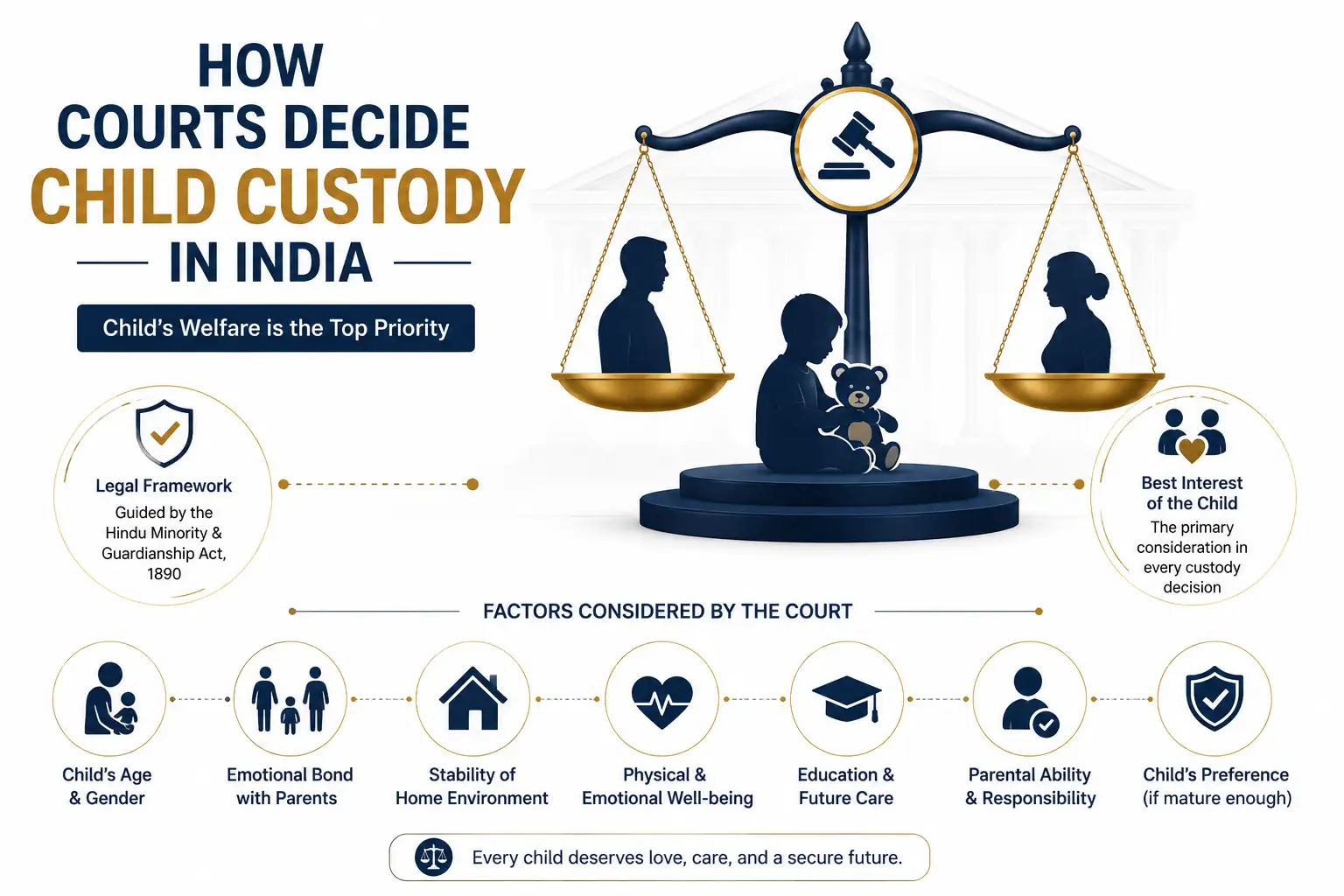
Child custody battles often make people think and feel selfish. But try seeing a custody battle from the child’s point of view. A custody battle is rarely about two parents divorcing or two households splitting up. From the child’s perspective, it is about their family breaking into two separate homes. In the middle are they – often confused, often scared and most certainly pulled in two different directions emotionally. “How long will this take?” is the parent’s immediate concern. “Will you still love me?” is the child’s quiet question. Want to know how courts decide child custody in India and what parents can do to protect kids? Read on… Family and kids remain the heart of Indian society. Custody battles have become more stressful because modern families often live in different Indian cities, both parents work outside the home, children attend competitive schools and universities, and marital separation is sometimes accompanied by cruelty allegations, money pressure, neglect claims, drug or alcohol abuse or emotional manipulation. Take a common scenario. A mother takes the child to Delhi and blocks access to the father in Noida. Why? Perhaps the father works in Gurugram and forgot to spend enough time at home. The mother may have an argument, but her solution only fractures the child’s world. What starts as a parent’s problem involving angry blame becomes the child’s problem. Suddenly the child has to adapt to living in one home instead of two, plus new neighborhood, schools, commuting time and possibly grandparents or domestic help they rely on. 2026 will bring more custody battles, but courts will continue to look past parental conflict and assess what living situation protects the child’s welfare the best. Legal aspects may differ slightly city by city but many Indian parents share the same problems: Indian child custody fights will always focus on this question: What is best for the child? The same is true for high conflict divorces in Delhi NCR. Advocate BK Singh often hears this one piece of advice when counselling parents: Stay focused on the child. If you hurt the other parent, that’s your choice. Do not hurt your child. Parents have a fundamental right to legally protect their child. But when it comes to child custody in India, it is not parental rights that dominate the court’s decision. Instead, judges want to protect kids. Courts balance parents’ rights with responsibility towards children. Advocates must argue not just law and evidence, but what will practically keep the child safe. Child custody in India means the legal and practical relationship under which a minor child lives with a parent, guardian or meets the other parent through visitation/access. Courts look at each family situation carefully. The final order varies depending on facts of each case. But the test remains constant: what custody and access arrangement serves the child’s welfare the best? Under custody, a court can decide: Courts sometimes divide custody into physical custody, legal guardianship and visitation/access rights. Guardianship is a related legal concept. Who has custody of the child may differ from who is legally declared the guardian. A parent may have custody and visitation rights but share guardianship responsibilities with the other parent or family member. Indian law recognizes Hindu guardianship laws under personal statutes, but in custody cases the welfare principle from the Guardians and Wards Act will dominate. Here is an example. Mother A is a natural guardian under Hindu law. But father B has worked extra hours to provide food, shelter, education and medical care for child C. A wants sole custody and nothing to do with B. Solution? B can show the court evidence of his care and ask for custody and access to ensure he remains a constant in child C’s life. A might be child C’s natural mother under Hindu law, but her conduct does not favor granting her physical custody. B’s work schedule and involvement in home matters do not outweigh his involvement with C. Courts decide child custody in India based on welfare of the child. Typically a District Court or Family Court handles custody cases. The Guardian and Wards Act, 1890, Family Courts Act 1984 and individual personal laws govern custody. Courts prefer shared parenting agreements but assess each child’s age, needs, parental involvement, abuse allegations and safety before crafting custody/access orders. Parents cannot decide child custody alone – a court must approve agreements. If one parent has custody, the court may grant visitation/access rights to the other parent. Parents may also agree to travel periods for holidays, video calls, summer vacations and educational travel if it is safe and not unfair to either parent. The Guardians and Wards Act, 1890 (GW Act) allows courts to appoint guardians for minors. Under the GW Act, custody relates to care, control and maintenance of a child. Section 19 of the GW Act empowers courts to make orders regarding the property of a minor. Section 17 specifically states: “In every proceeding in which the appointment of a guardian of a minor, or the declaration that any person is guardian of a minor, is sought, the court shall be guided by what appears to be for the welfare of that minor and shall also have regard to the following matters, namely:-” (a) the wishes of the minor himself, if he is old enough to form an intelligent preference; (b) the sex of the minor; (c) the religion of the minor; (d) the character and capacity of the person applying to be appointed guardian; (e) the wishes of the person (if any) who was previously the lawful guardian of the minor; and (f) the nearness of the relationship between the minor and the person applying to be appointed guardian. India also has a Family Courts Act which establishes Family Courts to deal with matrimonial disputes including child custody battles. Under Section 9(2) of the Family Courts Act, jurisdiction over children also includes “matters concerning the custody of, access to, and maintenance of children”. Meaning children’s custody and access are governed by both the GW Act and Family Courts Act. Practically speaking most custody cases are filed in Family Courts. India has personal statutes governing Hindus, Muslims, Christians and other religions. Family courts will typically allow parties to argue how their religion impacts custody and guardianship of the child. For Hindus, there is the Hindu Minority and Guardianship Act, 1956. Section 13 specifically states: “No Guardian of, or person in position of a guardian to, a minor shall be entitled to appoint himself Guardian of such minor or make any other appointments contravening the proviso to Section 5, if the Court is of opinion that the appointment of such guardian or the making of such other appointment as the case may be would not be for the welfare of the minor.” Again we see how the welfare principle will apply no matter what custody relief is sought. Courts issue custody orders when parents separate during divorce proceedings. Parents sometimes file custody petitions on their own if there is no divorce case. In instances where domestic violence is present, courts can decide custody in a standalone DV complaint or within divorce filings. The same goes for child custody withinGuardianship petitions and habeas corpus petitions if one parent unlawfully removes a child to another city or state. Essentially any matrimonial dispute involving minor children can raise custody concerns, but the correct forum depends on facts. A parent should not assume every dispute requires filing the same lawsuit. Once in court, relief ranges from temporary custody orders and visitation to supervised access, final custody, holiday visitation orders and even video call directions. But courts use their discretion wisely. Parents cannot demand a court grant certain custody just because they want it. Parental custody is the norm for younger children, but shared parenting becomes practical for school going kids. Courts evaluate custody cases from various angles to determine what truly serves the child’s welfare. No single factor is decisive. Babyhood requires greater care and often physical custody by one parent. But what if both parents work? Courts analyze practical living arrangements for young children. School-aged children have different needs. Who has been taking the child to school? To doctor’s appointments? Who does grocery shopping? Will changing schools disrupt the child’s education and social development unduly? For teenagers, courts are more likely to examine the child’s own comfort and routine. But they will also investigate if any parent manipulated the child’s preference or made him fearful. If one parent has always been there – taken the child to school, managed doctor visits, attended parent-teacher meetings and cared for daily needs – this parent can show the meaningful emotional connection they provide. Buying expensive gifts suddenly after custody battle begins does not hold as much weight. Judges want to ensure the child will feel emotionally safe with parents. Avoid disrupting schooling, sleeping, medical and eating routines when possible. If one parent moves with the child to another city but schools stay the same, access challenges, health care availability and living conditions become key concerns. Courts are not necessarily against city relocation if the child’s education, health and stability improve. But be prepared to show evidence why welfare demands a change of residence. Has one parent insulted the other constantly in front of the child? Words matter. If you know you lost your cool, show conduct improved after the incident occured. If the other parent is refusing court ordered visitation unjustifiably, highlight this conduct. Courts are aware no family is perfect, but deliberate violations of court orders should not be tolerated. Courts will examine credible evidence of violence, addiction, neglect, mental cruelty, unsafe living conditions or negative influence from grandparents carefully. Merely being a stern parent does not make you safe for granting custody. But making material allegations against the other parent requires solid proof. A single unsubstantiated allegation can weaken your credibility if the court calls for counter evidence. Parents fighting over child custody need this guide. Parents preparing for divorce and seeking to understand child custody implications should read this guide. Individuals having unjustifiably lost access to their child should consult this guide. Parents falsely threatened with losing custody should read about their rights. People hoping to modify existing custody orders based on change of circumstances can also benefit. Simply put, anyone wanting to know how courts decide child custody matters in India should read this article. If you want more help understanding custody and visitation arrangements based on facts specific to your situation, contact Advocate BK Singh for a free initial consultation. Has your ex stopped all access to your child? Took the child to another city without consent? Threatened to switch schools or block Skype calls? Changed their work schedule to avoid being at home? Each problem can have a legal solution. Start with facts. Document your concerns. Courts look at evidence. Keep records of school fee payments, doctor visits, your daily involvement in caring for the child. Take date-stamped photographs of you both together on holidays, weekends and special events. The more proof you have showing you actively care for your child’s welfare, the easier it becomes to show a judge your involvement. Custody cases depend on each child’s age, location they live and attend school, each parent’s relationship with the child, if any litigation is pending between parents, and many other subtle factors. Custody cases require thoughtful strategy. A good lawyer will carefully analyze what relief you should immediately seek. Do you need temporary custody right now? Must visitation be ordered to stop your ex from unfairly relocating with the child? Your lawyer should lay out options after reviewing facts. Carefully drafted filings help judges understand your position quickly. Emotional statements are best left out of petitions. Stick to proven facts and realistic requests that benefit the child. Once filed, the court may issue notice to the other parent, listen to both sides, refer the case to mediation, examine the child if necessary, and post interim orders to protect the child’s welfare. Delay is not inevitable. Family courts know children suffer when parents fight endlessly. If possible, parents can work out scheduling details like meetings every weekend, alternating holidays, special birthdays, festivals and video calls. If both parents behave reasonably, drafting a parenting plan may be faster than contested court hearings. Parents should not blindly attack each other without proof. Make notes and collect documents that support your stance. Here is a basic evidence checklist for custody battles: Delhi courts see family cases faster than some other Indian cities due to listing pressure. Courts in tier-2 cities may take longer to schedule hearings. Claims of urgency must be backed by proof of school changing, denial of access, overseas relocation threats, etc. However, if you can prove immediate harm to the child’s welfare exists, a judge may permit urgent hearing of your application. Interim relief waits on urgency. Parents who stay calm and legally protect their side without abusing the court’s time often see faster results. Parent want to protect their kids. But in custody battles emotions can run high. Here are some mistakes parents make that harm an otherwise strong custody case: Angry parents who file abusive messages against each other never look like good guardians in court. Delhi.parents sometimes stop the other parent’s access to the child without valid reason. Courts punish this conduct if it unfairly isolates the child from one parent. Stalking the other parent, badmouthing constantly, wasting court’s time with false accusations and filing endless complaints will earn neither parent credibility with a judge. Too many parents pressure kids to choose sides. Sending evidence of such conversations to court is harmful to your custody battle. Fight divorce, don’t endanger your child. Threatening unrelated criminal complaints to manipulate a custody outcome looks ugly to courts. If you need to move cities or change the child’s school for work or marital reasons, get court permission first if there is a custody battle pending. Bold words like “violent”, “dangerous” and “brutal” lose impact if every sentence of your petition contains them. Write a proof supported custody petition. Child custody decisions can go against you. If a court awards custody to your ex, you must graciously accept it. Losing parents who continue to violate orders look selfish. Courts know children need more than money. Just because you earn more, do not assume you will win custody. Consult a lawyer when you need legal advice specific to your facts. Are you being denied access to your child? Contact a lawyer to understand immediate relief options. The other parent plans to move the school or shift city with the child but won’t discuss your concerns? Search online for Divorce & Custody Lawyer in Delhi or nearest city and talk to someone. Prepare before situations worsen. Parental custody battles are fought every day in Indian courts. Just because you do not see the family down the street fighting does not mean custody battles do not exist. They do, and you should know how to respond legally if need be. Don’t wait for your ex to file first. Get help understanding your options first so you know what you want to achieve legally. Parents facing custody battles would benefit from consulting with a lawyer sooner. Children deserve both parents fighting for them, not senselessly against each other in court. Advocate BK Singh handles custody battles, divorce and family law disputes for clients in Delhi NCR and all over India. You can read about his background before contacting the law firm. NOTE: You contacted divorcelawyerdelhincr.com because you want help with child custody. You may also find our Child Custody Resources page helpful. Any question going unanswered above? Submit your question below. Limited free legal advice is available. Courts look toward the child’s best interests when deciding custody in India. Indian judges carefully examine each family situation before determining where a child should live and legal rights of parents regarding education, health care and welfare. Grandparents can file for child custody or guardianship. But grandparents will need to prove that living with them is better for the grandchild’s overall welfare than living with the parents. Visitation rights are the parents’ lawful right to access their child. If mother has physical custody, father can seek visitation rights. Until granted by court, parents may withhold visitation against the other parent’s wishes. Parents sharing physical custody is ideal but not always possible. Mothers do not always get custody in India. Judges want what is best for the child, not what one parent demands. Every case is different. Simple cases where parents agree to share custody may be quicker than high conflict cases where false allegations fly back and forth. If mother has physical custody, she can travel with the child. But if you need to take the child out of India, obtain travel consent from the court first. Parents may change child’s school if both agree. But in high conflict divorce cases where custody is disputed, one parent may need consent from the other parent or court to change the child’s school. Neither parent. Divorce does not automatically award custody to either parent. A custody case must be filed first.How Courts Decide Child Custody in India
Why This Issue Matters in India, Delhi NCR and Other Major Cities in 2026
Quick Facts Box
Child Custody Point
Practical Legal Position in India
Main test Welfare and best interest of the child Governing law Guardians and Wards Act, 1890, personal laws and Family Courts Act where applicable Mother’s custody Strong factor in many cases, especially for young children, but not automatic Father’s custody Legally possible where welfare supports it Child’s preference Court may consider it if the child is mature enough Visitation rights Often granted to the non-custodial parent unless harmful to the child Final outcome Depends on facts, conduct, documents and child welfare Understanding the Core Legal Issue
What are custody and access?
Don’t confuse custody with guardianship
Who decides child custody in India?
Access visits and holidays
What Legal Framework Do Courts Use for Child Custody in India?
Guardians and Wards Act
Family Courts Act 1984
Personal laws
Divorce and Child Custody Cases
What Factors Do Courts Consider Before Giving Custody?
Age and stage of the child
Emotional bond with each parent
Stability and routine
Conduct of the parents
Safety and allegations
Who Needs This Guidance?
Step-by-Step Process in a Child Custody Case
Step 1: Figure out exactly what happened.
Step 2: Gather documents.
Step 3: Meet with a lawyer who specializes in family law.
Step 4: File the appropriate petition or application. Attend court.
Step 5: Consider settlement and a realistic parenting plan.
Documents and Evidence Checklist
Evidence Type
Why It Helps
Child’s school records Shows consistency of schooling, parental involvement and education stability Medical records/diagnosis Demonstrates medical needs of child and who cares for those needs Communication history Proves denied access or, if you’re the custodial parent, that you allow visitation unless there is reason to be concerned Receipts showing who has paid for child’s expenses Documents who has been financially providing for the child Copies of prior orders or settlement if exists Shows what arrangement existed previously and if one parent is deliberately disobeying a court order Police complaint or DV complaint/fault finding orders Evidence of safety concerns related to leaving child in the other parent’s custody Photos/videos/date-stamped notes showing care of child Help prove who you are claiming provides day-to-day care to the child Travel history/details Passport info Demonstrate if the other parent has illegally taken the child abroad or plans to do so Timelines, Practical Delays and Decision Windows
What Common Mistakes Do Parents Make in Custody Cases?
Thinking of custody as revenge.
Blocking access to the child.
Behaving badly before/after filing.
Dragging the child into the fight.
Parents threatening criminal cases to win custody.
Altering school/city of child abruptly.
Filing exaggerated petitions.
Ignoring custody orders.
Thinking salary alone determines custody.
When Should You Consult a Child Custody Lawyer?
How divorcelawyerdelhincr.com Can Help
Frequently Asked Questions
How do courts decide child custody in India?
Can grandparents get custody of grandchild?
How many days can mother keep child from father in India?
Does mom always get custody?
How long does a custody case take in India?
Can I travel abroad with my child without father’s permission?
Can parents change child’s school in India?
Who will get child custody if parents are divorced?
Don't worry; Divorce Lawyer Delhi NCR explains everything in plain language without using legal jargon.
No stress and no confusing legal language, Divorce Lawyer Delhi NCR gives clear, honest guidance based on real case experience so the divorce process stays simple and easy to understand.
Schedule Your Consultation