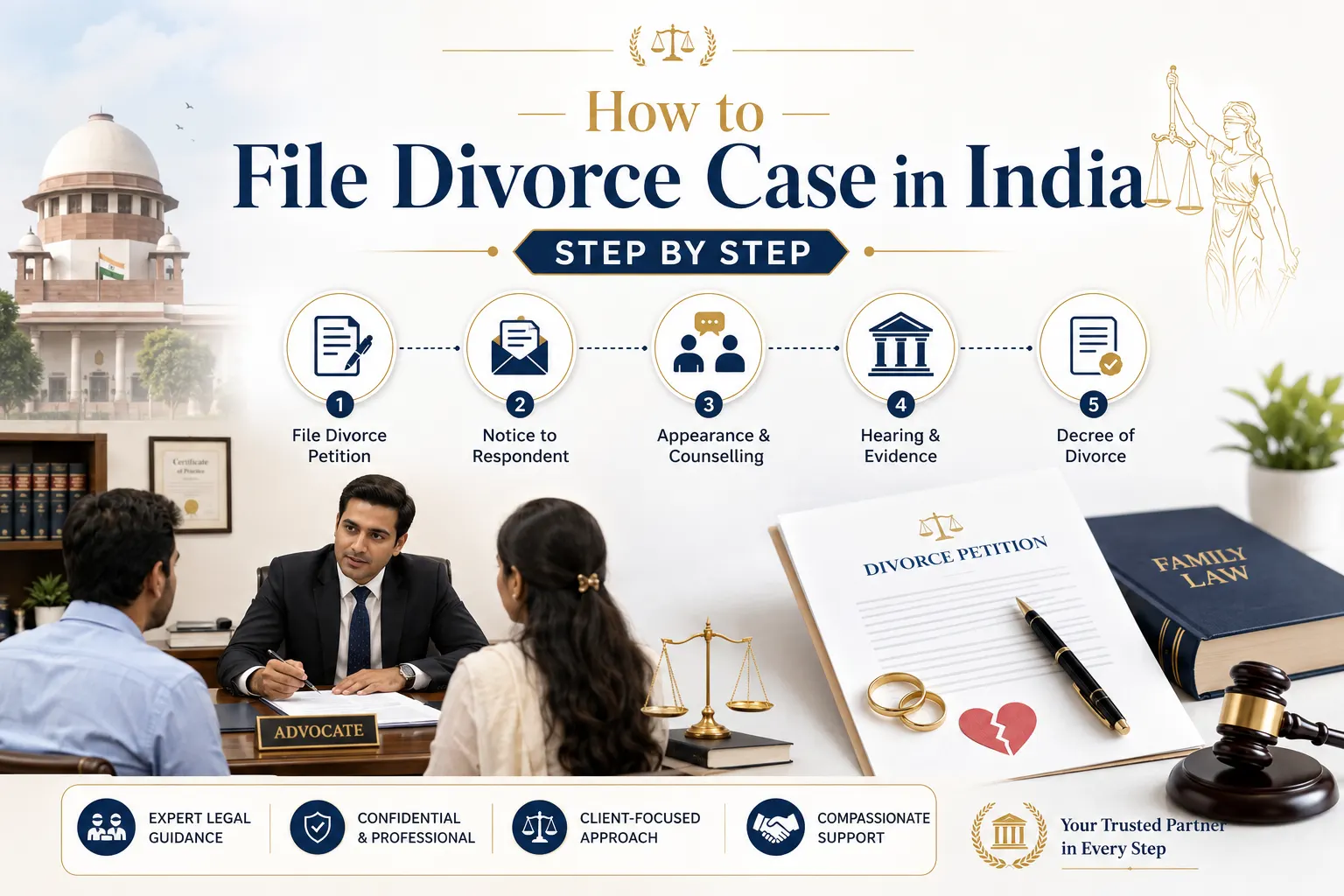
You can’t just go to family court in India and say, “Hey judge, I want divorce”. Divorce in India involves different steps based on your marriage type, personal law, if spouses are agreed or not, if children are involved and many more factors like existence of maintenance/alimony claims, pending domestic violence complaints, 498A cases, property disputes or custody battles. More often than not, people face difficulties not because divorce law is hard to understand. They face difficulty because they start blind. Sometimes people file the case out of anger. Sometimes they sign settlement without reading it. Sometimes they wait too late to take legal advice until the opposite party has filed a legal notice/complaint against them. Hence we provide information about how to file divorce case in India step by step in easy language and practical, high level manner. Divorce Lawyer Delhi/NCR advocates for clients through mutual consent divorce, contested divorce, divorce petition drafting, maintenance/alimony claims, divorce mediation, child custody matters, matrimonial defense in domestic violence and 498A complaints, family court hearings and settlement agreements throughout Delhi NCR and India. To file divorce case in India, you should understand whether the parties are filing for mutual consent divorce or contested divorce. Then you must check law, grounds for divorce, jurisdiction, documents required, child custody concerns, maintenance/alimony claims (if any) and possibility of settlement. With the help of a lawyer, you can draft divorce petition and file it before the Family Court. Clients should first talk to a lawyer. Family law matters involve drafting, jurisdictional issues, financial claims like maintenance/alimony, potential evidence and custody matters. Only a qualified lawyer can help you understand these aspects and advise accordingly. Divorce involves paperwork from day one. Whether it’s a mutual consent divorce or contested divorce, getting documents ready from the beginning helps. Before filing divorce, lawyer should check where the divorce case can be legally filed. Divorce can be filed by consent when both spouses agree they want divorce. If any one spouse does not agree for divorce or any allegations are contested, the matter becomes contested divorce. Divorce petition must be drafted keeping in mind the facts of the case. Written documents carry weight in family court. Weak or emotional divorce petition will harm, not help. Every city in India and Delhi NCR has Family Courts under district judiciary. Family court of right jurisdiction should be chosen for filing. Depending on the type of case, either notice is served or parties appear jointly before court. Family courts encourage mediation. If issues are settled, divorce decree is quick. If the matter is contested, then reply to divorce petition, present evidence and hear arguments. Final divorce decree/order is granted by Family Court. Disclaimer: Different cases require different strategies. Also, above route may vary because it is only a high level preview of steps. Every divorce case is different. For instance, a divorce case where husband and wife both agree to divorce under mutual consent is very different than contested divorce case where wife has made serious allegations and husband has to defend them. Where wife is filing for maintenance, or husband is filing for divorce and wife has turned hostile, cases would require different strategies. Mutual consent divorce is when both parties agree that they want to get divorced. They have already separated (usually) and may have worked out financial claims, custody of child (if any) and decided to settle the marriage through mutual consent divorce petition. One mistake couples make is that since both of them agree for divorce, they don’t think much about divorce settlement. It is not how divorce happens in India. Both of you may agree on divorce. But what about expenses for your child? Who will take custody? Is wife keeping your jewellery? Has husband taken all of his from her? Agreement on divorce is one part. But written settlement terms are also important. In mutual consent divorce, you don’t argue in court. But if terms are unclear, disputes may begin after divorce decree is granted. Learn how to file Mutual Consent Divorce in India Step by Step Contested divorce is required when one person wants divorce and other does not agree for divorce. Or both may agree that they want divorce, but one spouse contests allegations or refuses to accept agreed alimony, custody or financial claims. Grounds for contested divorce include cruelty, mental cruelty, adultery, desertion, conversion to another religion, renunciation and more. Once specific grounds are identified, contested divorce petition can be filed against spouse. “I want to divorce wife because my wife tortured me mentally”. Above statement is weak if no facts are mentioned. Family court wants to know what happened, when it happened, if there are any proof messages, if there were witnesses, and how such conduct affected your married life. In India, divorce is filed before Family Courts which come under district judiciary. Before filing a divorce petition, you must know where you can legally file the case. This is called jurisdiction. Jurisdiction is decided on various factors like where couple got married, where husband and wife last lived together, where wife is living now (in some cases), where respondent spouse resides and where cause of action (grounds for divorce) has arisen. Divorce cases in Delhi NCR can be filed in Family Courts at Delhi, Noida, Gurugram, Ghaziabad or Faridabad Courts. But narrow jurisdiction would depend on facts. For example, in Delhi, family matters fall under Family Courts at Saket, Dwarka, Rohini, Tis Hazari, Karkardooma or other court complexes depending on where marriage took place, couple lived together or wife resides. Important: Just because your friend filed divorce in Mahila Court close to your house, doesn’t mean you can file your case there. Transfer of cases from one court to other takes time. Avoid filing in wrong court. Documents are crucial when you want to file divorce. Evidence speaks louder than words. From day one of marriage, keep paper trail ready. Don’t create any document after dispute arises. Divorce case looks crappy when husband is shown passing Salary slips of year 2020 in year 2023 divorce case just because he was asked to produce them. If legal grounds for divorce exist, husband can always file divorce against wife. Along with divorce petition, husband may have to deal with maintenance claims filed by wife, domestic violence case filed by wife, allegations of dowry harassment or cruelty and false allegations. Divorce should not be done in anger. Stay practical and let lawyer handle battles. If legal grounds for divorce exist against husband, wife can file divorce petition in India. Along with divorce, wife can claim maintenance and alimony, file for child custody, claim residence rights under domestic violence law, return of stridhan and more. Legal notice before divorce is not mandatory in every case. But in certain divorce cases, it helps. A divorce notice can be sent to put allegations on record, ask for return of belongings, propose mutual consent divorce or respond to unfair accusations. Divorce notice should be drafted after careful analysis. Don’t write something extremely wicked just to scare the other party into settlement. Once it’s written on paper, it can be used against you in family court. Divorce isn’t the biggest challenge. Money and kids are. Both spouses have the right to ask for maintenance from the other spouse during divorce proceeding. Alimony can also be asked for or offered as onetime settlement. Married couples also fight for child custody and child visitation rights. Court considers: Child custody of husband and wife is decided based on welfare of child. Which parent will get custody? The court does not see it as a privilege. Rather factors like child’s stability, safety, love, schooling and overall well-being are kept in mind. Divorce cases often go to mediation in family courts in India. Many times, parties are able to settle their disputes through mutual discussion if they leave emotions aside. During mediation both parties can discuss and settle alimony, child custody and visitation, stridhan issues, pending cases and future claims. How to settle during divorce? Simple. Don’t settle until it’s clear. Clarity kills confusion. Make sure you and your lawyer understand every clause in the agreement. Everything you say or agree to should preferably be in writing. Verbal isn’t worth much. husband and wife agreed on mutual consent divorce. Both parties settled alimony amount and signed agreement. They were about to sign the decree when wife suddenly said husband was not taking child to school everyday. Husband was in shock. He did not know wife was complaining. He thought divorce was done. Final argument stage delayed mutual divorce because of paid argument attorneys. wife and husband were fighting for custody of child. Wife had asked for divorce on grounds of mental cruelty. But husband had no date-wise incidents or proof. He only made allegations against wife. During evidence stage, wife’s attorney grilled him on incidents he wrote about. He could not give proper answers. wife wanted divorce. But before taking any legal steps, she prepared all documents. This helped her file divorce case faster and with better divorce petition. Documents reviewed: Her lawyer was able to prepare a better divorce petition because he had evidence to go through. Preparing for divorce and filing takes time. Seek divorce advice if you are thinking about filing mutual consent divorce or contested divorce, sending legal notice, claiming maintenance/alimony or negotiating divorce settlement in Delhi NCR or India. Consult a divorce lawyer, understand your options, collect evidence, and file divorce petition before Family Court. Yes. Husband can file divorce if legal grounds exist. Both spouses can also file for divorce by consent. Yes. Wife can divorce husband for valid reasons. Or both spouses can file for mutual consent divorce. You need proof of marriage, identity and address proofs of both spouses, income documents, any evidence related to grounds of divorce and more. Not necessarily. But in some cases, legal notice can help you propose mutual consent divorce or record marriage related facts. Both spouses file for divorce with mutual consent when they both want divorce. On the other hand, contested divorce is filed by one spouse and allegations are contested by other spouse. If you file for mutual consent divorce, divorce is quicker. But contested divorce takes time, depending on facts and documentation. No. If wife does not agree for divorce, husband can still file contested divorce against her. Consulting a lawyer helps you understand divorce, jurisdictional concerns, grounds for divorce and important paperwork. advocates for clients fighting divorce cases, adultery claims, divorce by mutual consent or contested divorce, divorce mediation and more in Delhi NCR and India. Excellent services provided by bk Singh Fist time came for consultation meeting for my case and He literally explained every doubt and possibilities .And did’nt force anything upon us also made us understand law also. He is very knowledgeable lawyer. December 22, 2020 Good service Had done very good consultation regarding my divorce case. Explained very well about rights and explained procedure very well too. I am satisfied with the consultation. January 25, 2021 Really Good and Helpful He listens to your problem, understand it and then proceed with it. Also he explains about possibilities before proceeding. Very good experience with him. December 22, 2020 Very Professional… Explained well about how things work. Can recommend anyone and everyone to consult him. Thank You Sir… January 20, 2021 Divorce lawyer helps my case Lawyer helped me out very good. Advised me properly and could understand the situation completely. Everyone should consult him. December 22, 2020 Happy Client Forever Made me feel very comfortable while talking and tried to give my case fast-tracking. Thank you so much. January 19, 2021 For everything related to divorce – lawyers in India, divorce mediation or divorce procedure steps in India, call or reach out to us today to set up a consultation about your situation.How to File Divorce Case in India Step by Step – Ultimate Guide
Summary on How to File Divorce in India
Details on Filing Divorce in India
Legal consultation
Documents review
Jurisdiction
Mutual consent divorce or contested divorce
Draft divorce petition
File divorce petition before Family Court
Notice/costs or joint appearance
Mediation/settlement discussion
Reply/evidence/hearing in contested cases
Grant of divorce/order
How to File Mutual Consent Divorce in India
Terms to be settled in mutual divorce
Mutual divorce trap: “We both agree, so nothing can go wrong”
How to File Contested Divorce in India
Remember: Don’t write emotional story. Write facts with dates, incidents and evidence.
Real-Life Contested Divorce Example:
Where to File Divorce Case
Documents for Divorce
Documents you should keep safe (they’ll come handy later)
Divorce from Husband’s Perspective – India
Documents and preparation tips for husband before filing divorce in India
Divorce from Wife’s Perspective – India
Documents and preparation tips for wife before filing divorce
Divorce Notice Before Filing Case
When you should send legal notice before divorce
Maintenance, Alimony and Child Custody Considerations
Mediation and Settlement Discussions
Sample Divorce Settlement Terms
Real Life Mutual Divorce Story 1: Avoid Paid Arguments
Learnings: All terms should be clear before you settle. That way there won’t be any confusion later.
Real Life Divorce Story 2: Contested Divorce Failed Due to Lack of Evidence
Lesson Learnt: Every statement in your contested divorce petition should have proof. Dates, screenshots and witnesses help.
Real Life Divorce Story 3: Documents Ready Before Filing Divorce
Lesson Learnt: There can be no preparation like preparation before filing divorce case.
The top 10 Mistakes While Filing Divorce in India
Divorce Filing Fast Takeaways
FAQs – Divorce Procedure in India Step by Step
How do I start divorce proceedings in India?
Can a divorce be filed by husband?
Can divorce be filed by wife?
What are the documents required for filing divorce?
Should we send legal notice for divorce?
What is the difference between mutual consent divorce and contested divorce?
How long does divorce take in India?
Do I need the consent of my husband to file divorce?
Do I need a lawyer for divorce?
How can Divorce Lawyer Delhi/NCR help?
Divorce Consultation India
Client Reviews
Join 10,000+ Indians who got divorce help from divorce lawyer delhi/ncr
Don't worry; Divorce Lawyer Delhi NCR explains everything in plain language without using legal jargon.
No stress and no confusing legal language, Divorce Lawyer Delhi NCR gives clear, honest guidance based on real case experience so the divorce process stays simple and easy to understand.
Schedule Your Consultation