How to Get Guardianship of a Child
When a parent dies, gets very sick, moves away, or can't take care of a child anymore, the question of who will look after the child becomes very important and personal. In many Indian families, grandparents, close relatives, or even a surviving parent need to know the law so they can make decisions about school, health care, travel, property, and daily needs without any problems in the future. A proper guardianship petition is not just a formality in court. It gives the caretaker the legal right to do what is best for the child and protects the child's life. This is why a lot of families choose to get help from Divorce Lawyer Delhi NCR and Advocate BK Singh as soon as possible.
In real life, guardianship issues often come up when things are tough emotionally, like when one parent dies, a husband and wife separate, or there is a fight over custody or the child's property. Families in the middle class often worry about delays, pressure from the court, paperwork, and whether their child will have to go through a stressful legal battle. That fear can be lessened by good legal help. Families can move forward with more confidence and less confusion if they have clear paperwork, a practical case strategy, and a focus on the child.
1. What it means to be a guardian of a minor child in India
Guardianship of a minor child means that the law or a court gives someone the power to take care of the child and make important decisions about the child's well-being. This power could have to do with the child themselves, their belongings, or both. In India, the court does not automatically choose the closest relative. The child's safety, emotional stability, education, health, and financial protection are always the most important things to think about.
A lot of people think that guardianship and custody are the same thing, but that's not always the case. Custody usually means who takes care of the child every day, while guardianship can also mean having the power to make legal decisions and control the child's money. This difference matters when a grandparent, uncle, aunt, or other relative wants to have the legal right to make decisions about the child's future without other family members constantly objecting.
2. When families need to get guardianship
A guardianship petition is needed when there is no clear legal answer to the question of who should be in charge of the child or when someone needs the court's help to protect the child's well-being. This often happens when one or both parents die, when a child is abandoned, when a parent has a mental illness, when a parent is in the hospital for a long time, when a parent is in jail, when a parent remarries, or when there are serious family fights. It is also necessary when the child has money, property, or other assets that need to be legally supervised.
Families in Delhi NCR often try to handle things informally at home first, but later they run into problems when they apply for school, a passport, medical help, bank work, or property paperwork. At that point, officials usually ask for formal legal authority. Divorce Lawyer Delhi NCR and Advocate BK Singh help families all the time who want to avoid future problems by taking legal action right away instead of waiting for the problem to get bigger and more expensive.
3. Who can ask to be a guardian for a child?
A biological parent can apply, but in many cases, grandparents, adult siblings, close relatives, or someone else who really cares for the child can also ask for c. The court looks at how the applicant is related to the child, how stable their finances are, their character, their living conditions, how much they are involved in the child's life, and how well they can give the child emotional and practical support. A blood relative may have an advantage, but the court isn't required to choose them.
If a child has lived with their maternal grandparents for years and the surviving parent has been neglectful, violent, addicted, or completely absent, the court may see the grandparents as a safer and more stable choice. Also, if a family member is trying to take control just to get to the child's property, the court can turn down that request. This is why the case needs to be built on facts, documents, and a presentation based on the child's best interests, not just emotional claims.
4. Documents that are usually needed for a guardianship case
The documents needed depend on the situation, but families usually need the child's birth certificate, proof of identity for the applicant, proof of relationship, proof of address, photos, school records, and information explaining why guardianship is needed. Death certificates are essential if one or both parents have died. If the issue has to do with separation, neglect, or incapacity, medical records, police reports, court documents, or communication history may also be important, depending on the situation.
If the child has property, insurance benefits, money from an accident, or inherited assets, the court may ask for property records, bank statements, valuation documents, or papers that show how the child is financially interested. Strong documentation makes the petition more believable and cuts down on unnecessary objections. Advocate BK Singh stresses the importance of careful paperwork because a well-documented petition can change the court's first impression and make the case stronger overall.
5. Which court in India deals with guardianship issues?
Depending on the case and the local legal system, guardianship cases are usually filed in the right family court, district court, or guardian court. Jurisdiction is often based on the minor's usual residence, not just the requester's. This is important because filing in the wrong court can waste time and slow down the process. A lot of families think that any nearby court will work, but it's important to check jurisdiction carefully before filing.
Families in Delhi NCR and nearby areas often need help deciding whether to file the case where the child goes to school, where the child lives, or where the family's property is located. Every set of facts needs to be looked at legally. Divorce Lawyer Delhi NCR helps families know which court to go to before they start the case. This way, the petition moves in the right direction from the start and doesn't get stuck in unnecessary technical objections.
6. How the court chooses who should be the guardian
The most important thing to consider is the child's well-being. The court will look at who can give the child a safe place to live, emotional support, a good education, medical care, moral guidance, and financial responsibility. If the court thinks the child is old enough to make a meaningful choice, the child's wishes may also be important. The court can also look at how parents or other family members have acted, such as abuse, neglect, instability, manipulation, or not being involved in the child's life.
A guardianship case shouldn't be seen as a fight for property or family honor. Judges can tell right away when adults are fighting for control but not for the child's best interests. A case that is calm, honest, and focused on the child usually holds up better than a case with a lot of family drama. Families who want a practical presentation in court often choose BK Singh Advocate because a well-structured and measured case can make a big difference in sensitive child matters.
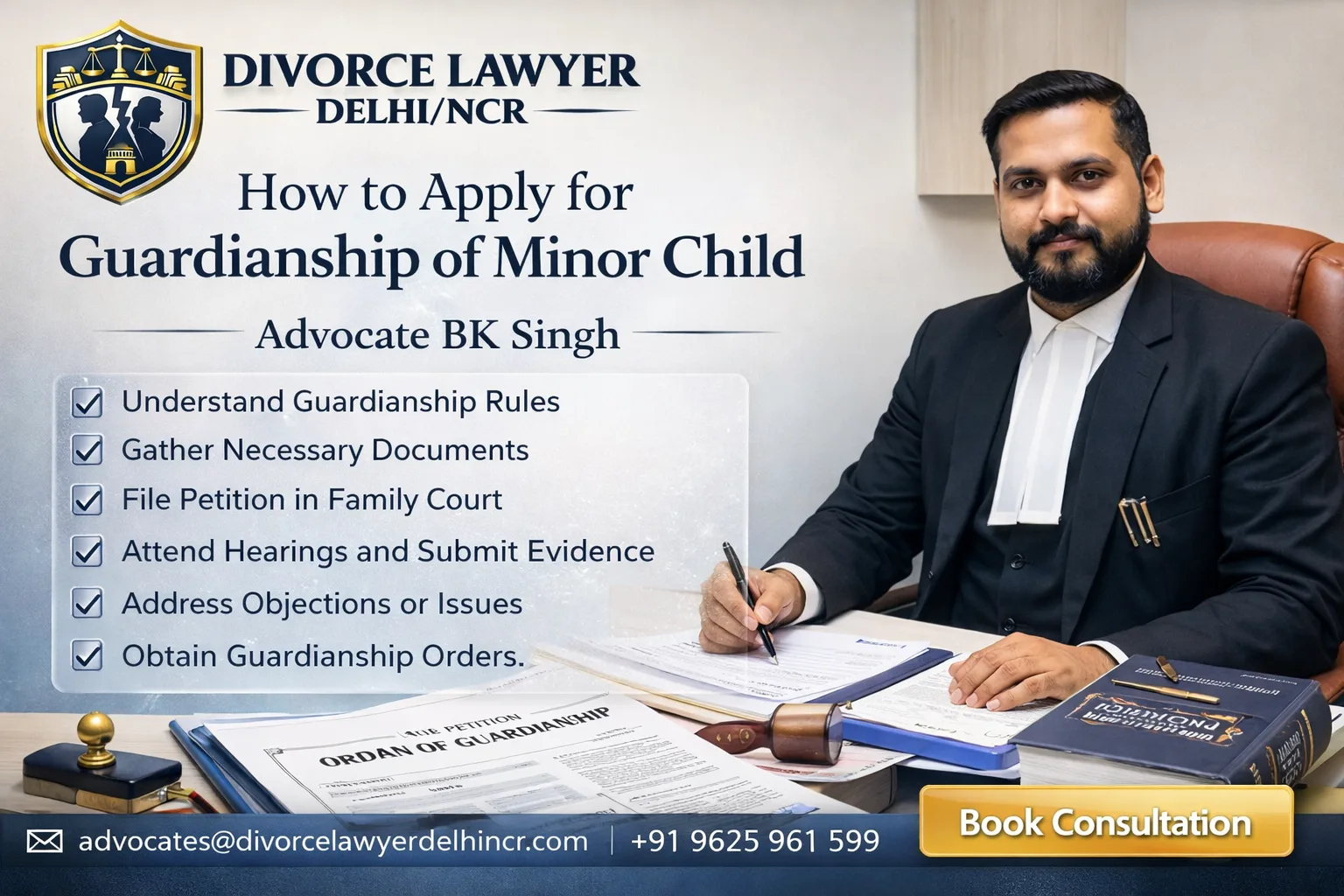
7. How to apply for guardianship step by step
The first step is usually to talk to a lawyer to learn about the child's situation, their relationship history, and any urgent problems with school, health, or property. After that, the petition is written up with all of the important facts, legal reasons, and supporting papers. Then, the petition is filed in the right court. People who are interested may get notices, answers may be filed, and evidence may be put on record. The court may talk to the child or ask for proof of their living conditions in some cases.
After hearing both sides and looking over the evidence, the court may issue an order naming a guardian with certain rights and responsibilities. The process may go more smoothly in simple, uncontested cases. When there are disagreements between family members or a parent objects, the case can take longer and needs more preparation. This is where professional case planning is important, especially for middle-class families who can't afford to make the same mistakes over and over again and have to keep putting off their cases.
8. Common problems and how getting legal help makes them easier to deal with
Family objections, missing documents, fights over the child's property, false accusations by relatives, confusion between custody and guardianship, and worry about how the child will be treated in court are some of the most common problems. Some people who apply are also afraid that they will be turned down because they are grandparents, single women, working professionals, or relatives who live outside the city. In reality, the court looks at the overall welfare and stability of the situation, not just what people think or what society says.
Legal help is helpful because it gives an emotional problem a structure. A good lawyer can help you find the right court, write the petition correctly, get the right papers, deal with objections, and present the case in a way that puts the child's best interests first. Divorce Lawyer Delhi NCR and Advocate BK Singh help families stay focused on legal protection instead of family chaos by giving them clear next steps, careful drafting, and realistic advice.
Client Reviews
*****
Ritika Sharma
When my sister died and left her young son in our care, I went to see Advocate BK Singh. We were heartbroken and didn't know how to get legal guardianship. He explained each step in plain English, took care to fill out the forms correctly, and was very caring about the whole thing. He never treated it like a normal file, which made me feel better. He knew that this was about the child's future. Our family finally got peace and legal clarity.
*****
Imran Khan
I needed legal guardianship for my daughter after a hard family fight so that I could handle her school records and medical decisions without anyone bothering me all the time. Divorce Lawyer Delhi NCR helped me in a very useful way and took away my fear of how the court works. The drafting was good, the filing went well, and the advice stayed honest all the way through. I felt like I had support at every step, which made a hard situation easier to deal with.
*****
Neha Verma
My parents were taking care of my late brother's young daughter, but we had to fight for every little thing because we didn't have a court order. Advocate BK Singh dealt with the situation with patience and clarity. He told us which documents were important, what the court would look for, and how to avoid making things more complicated than they needed to be. We were especially happy with how respectfully the case was presented. My parents can now take care of the child's education and well-being without worrying about the law.
*****
Sandeep Yadav
I wanted to find someone who could help me with both the legal and emotional parts of a guardianship case. BK Singh Advocate gave that balance. He didn't make empty promises; instead, he laid out a clear plan and put the child's needs first. It wasn't as scary because we always knew what to do next. That kind of help means a lot to families who are going through a hard time.
*****
Pooja Malhotra
In our case, there were objections from family members and confusion about the minor child's inherited property. We were worried that the issue would get messy and take years to fix. Advocate BK Singh helped us get the papers in order, answer objections correctly, and present a calm, child-centered case. His way of doing things seemed responsible and comforting. I really felt like there was someone we could count on in our family during a hard time.
?FAQs
1. How do I get guardianship of a child in India?
You usually need to file a guardianship petition with the right court in the area where the child usually lives. The petition should say who you are in relation to the child, why guardianship is needed, and how appointing you would be best for the child.
Q2. Can grandparents get guardianship of a child who is not yet an adult?
Yes, grandparents can apply, especially if the parents are dead, missing, unfit, or unable to care for the child. The court will look into whether the grandparents can give the child a safe, stable, and supportive place to live.
Q3. Is guardianship not the same as child custody?
Yes, they are related, but they are not always the same. Custody is mostly about where the child lives and how they are cared for every day. Guardianship, on the other hand, can also include the legal power to make big decisions and manage the child's money or legal interests.
Q4. What court is in charge of minor guardianship cases?
The right court depends on the facts and the area, but these kinds of cases are often brought to the family court, district court, or guardian court. Where the child usually lives is often an important factor in deciding who has jurisdiction.
Q5. What papers do you need for a case of child guardianship?
Some common documents are the child's birth certificate, proof of the applicant's identity and address, proof of the relationship, death certificates if they are needed, school records, photos, and papers that show why guardianship is needed. You might also need property records if the child owns things.
Q6. Can a single parent ask for guardianship or legal recognition?
Yes, a single parent can ask for necessary legal orders in certain situations, such as when there is a disagreement, the other parent is not present, or formal legal authority is needed to make decisions about property, education, or travel.
Q7. How long does it take to get guardianship in India?
The timeline depends on whether the case is being fought, whether notices are served without a hitch, and whether all the paperwork is in order. Things that aren't contested may move faster, but family fights or property problems can make things take longer.
Q8. Will the court talk to the child during the case?
Yes, in some cases. If the child is old enough and the court thinks the child's opinion is important, the judge may talk to the child in a careful and sensitive way to find out what makes them feel safe, what they want, and what is best for them.
Q9. Can a guardian take care of the property of a minor child?
A court-appointed guardian may have some power over the child's property, but this is limited by the law and the court, depending on the case. The court's main job is still to make sure that the child's money is not used for anything bad or in a way that causes problems.
Q10. Why do I need a lawyer to file a guardianship petition?
A lawyer helps you find the right court, fill out the petition correctly, get the right papers, deal with objections, and present the case in a way that is good for the child. This cuts down on delays, confusion, and the chance of making procedural mistakes in a sensitive family matter.
Don't worry; Divorce Lawyer Delhi NCR explains everything in plain language without using legal jargon.
No stress and no confusing legal language, Divorce Lawyer Delhi NCR gives clear, honest guidance based on real case experience so the divorce process stays simple and easy to understand.
Schedule Your Consultation