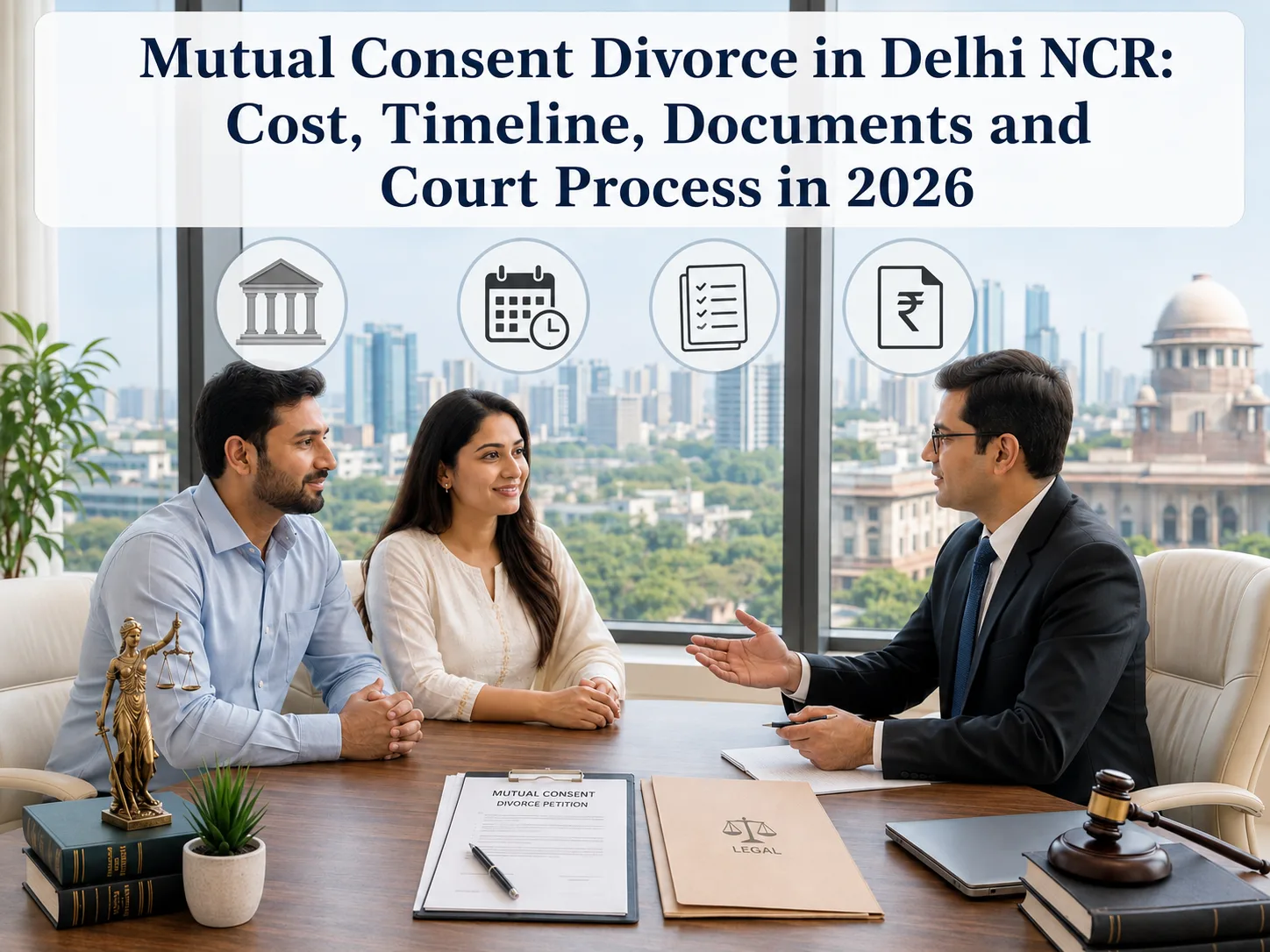
Divorce by mutual consent in Delhi NCR may be the easiest legal option when husband and wife decide to separate amicably. However “amicably” does not mean “nothing to discuss”. I have encountered couples who come to my office thinking “Bas signatures karne hain, divorce ho jayega.” Then the client hears “Terms of settlement need to be clear. Documents need to be executed. Court statements need to be handled carefully. Don’t you want custody of child? What about permanent alimony or lumpsum amount? What about maintenance?” Now the couple wants to discuss child custody, alimony, maintenance, stridhan, furniture and future claims. If you seek divorce in Delhi, Gurgaon, Noida, Ghaziabad or Faridabad in 2026, you want fastest, cleanest and least stressful ways to resolve your matrimonial dispute. Seek mutual divorce, but with caution. Both parties must agree on full settlement and understand the family court process. In this guide to mutual consent divorce in Delhi NCR, I try to cover the basics. You will learn about mutual divorce cost Delhi, mutual divorce timeline Delhi, documents required, first motion court statements, second motion court statements, cooling-off waiver and other court processes. You will also understand how to avoid common mistakes so you know what to expect beforehand. You can also contact a mutual consent divorce lawyer in Delhi NCR through divorcelawyerdelhincr for legal advice and guidance if you require assistance regarding settlement drafting or navigating court procedures. Divorce by mutual consent means both husband and wife have agreed that the marriage should end. Both parties file a joint petition for divorce before the Family Court. If you are governed by Hindu Marriage Act, you will do this under Section 13B. The Family Court will not grant you divorce simply because both parties say they want to separate. The court wants to ensure both parties have given free consent. Financial issues are settled. Child-related aspects are clear. There is no chance of reconciliation. Div Delhi High Court said this recently: The Delhi High Court said consent is important but waiver of timelines is not automatic. The Court has to be satisfied about the facts. The plain language meaning is this: both parties must agree on divorce. Both parties must go to court and tell their side of the story. Marriage breakup details, date of separation and future claims must be clearly stated. Mutual consent divorce works best when the following issues have been settled beforehand: How divorce petition is drafted makes a big difference later. A good divorce petition drafted by an experienced matrimonial lawyer can prevent conflicts later. A poorly drafted divorce petition may create disputes even if husband and wife decide to separate. Ok. Let’s face it. Litigation in contested divorce cases can take time, money and aggravation. In many family disputes, both husband and wife know there is no way to salvage the relationship. But they continue fighting because terms of settlement aren’t clear. A mutual consent divorce is a much more civil way to separate. That is why most couples in Delhi NCR prefer this method. Divorce is already stressful. This method saves spouses from awkward courtroom battles. Another benefit is you decide terms yourself instead of having a judge pass orders on every issue after long litigation. Take these two examples. The couple may agree wife gets a one-time settlement, both drop pending complaints, and no future claims can be made by either party. Husband and wife don’t have children. Another couple may agree to shared parenting, expenses towards school, visits during weekends, etc. Whatever couple agree outside court can be recorded in the settlement agreement and submitted before the Family Court in Delhi NCR. This means the role of a lawyer for mutual consent divorce in Delhi NCR becomes very important. Divorce lawyers are not just there to file paperwork. Divorce lawyers for mutual consent divorce must translate your settlement into proper legal language. Both husband and wife should know exactly what they sign. Amidst all these court process information about mutual consent divorce, I have realised one thing. The problem in most divorce cases is not the court process. The problem is ambiguous settlements. Parties often say “All issues settled” or “Everything has been worked out”. These terms become risky if the actual terms are not drafted clearly. If the settlement agreement is silent on future maintenance, pending complaints or jewellery, what prevents your spouse from filing claims later? That is why divorce settlement drafting is critical. One of the first questions asked by clients is cost. Its a valid question. Nobody wants to initiate a legal process and find that costs suddenly ballooned. Mutual divorce cost Delhi NCR varies based on facts. If both parties have no child, no property dispute, no pending complaints and no previous contested litigation, the cost will be less as compared to a case where alimony, child custody, criminal complaints, domestic violence and maintenance is involved. Also, some cases require multiple court appearances and meetings. Costs would vary accordingly. Here are things included while calculating lawyer’s fee: Here are some facts which help me estimate the cost: For most mutual consent divorces in Delhi, couples usually agree to pay a fixed-fee so there are no surprises later. If the matter is more complex, lawyers usually take fees stage-wise. This is the advice I can give you based on my experience. Don’t hire a lawyer just because his quote seems low. You may save money today but end up losing time later if the divorce petition does not mention settlement terms properly. In mutual consent divorce, clarity protects you the most. Mutual consent divorce timeline Delhi is something everyone asks. And the answer most people hear is six months upwards. Yes. Because mutual consent divorce has two motions. First motion and Second motion. During first motion, both spouses file petition and make statements before Family Court. Then comes the waiting period. After waiting period is over, second motion is filed. During second motion both parties confirm to court they still wish to divorce and consent has not changed. Indian Supreme Court has recognised that waiting period under Section 13B(2) may be waived in deserving cases where court is convinced that marriage has irretrievably broken down and further waiting will only add to the parties’ misery. Recently, Delhi High Court also clarified that court has powers to waive prescribed timelines in deserving cases but waiver is not something that can be demanded. It depends on facts. Putting it straight into Delhi NCR language. Here is how timeline works. Many ask if we can fast track mutual divorce in Delhi. Faster is relative. But not every matter can be fast tracked and no lawyer can guarantee X number of days for divorce. Mutual consent divorce involves consent, settlement and legal formalities. Timeline depends on facts and court listing. Let me give you one last heads-up on timeline. Even if one spouse changes their mind before decree is passed, family court cannot grant divorce just because you have filed first motion. Your consent should continue till the very end. Documents required for divorce by mutual consent sounds easy but many clients face delays because they do not have all the required documents. One tip: keep all these documents ready before you start drafting the divorce petition. Documents usually required are: If you do not have marriage certificate, you can still file a divorce petition relying on secondary evidence. Secondary evidence includes marriage photographs, invitation card, proof of marriage ceremony and affidavit from both parties. The point to remember is facts and court’s discretion. Documents like power of attorney, embassy attestation, notarised affidavit would be required if either spouse is NRI or living abroad. Video conferencing request can be filed if one spouse is outstation. These are details which should be confirmed at the start. A mistake I often see is couples downloading half-ready mutual divorce agreement from internet and filling in the blanks. Don’t do this. For general idea, it is fine. But when you agree on mutual divorce settlement, ensure the language of settlement matches the facts of your case. If there is a child, terms should mention who will have custody, visitation rights, school expenses, medical expenses, permission to travel abroad, access during birthdays/festivals, online/video calling rights and contact information during emergencies. If both parties agree on permanent alimony or lumpsum amount, mention how much is to be paid, by which mode and at what stage (complete payment or in instalments). Mutual divorce proceedings Delhi couples go through follows certain clean procedure. However, every family court has its own listing system and procedural practices. Your lawyer will ask you details such as when and where was marriage performed, last address where couple lived together, date of separation, reason for separation, details of terms settled upon and details of pending litigation, if any. Draft petition for divorce by mutual consent in Delhi will be prepared by your lawyer. Both parties should read petition carefully. Correct your lawyer if any facts are wrong. Settlement can be in the form of memorandum of settlement or can be part of divorce petition itself. Terms should be clear enough so that later neither party can argue about intentions. Petition is filed in the Family Court where jurisdiction lies. Jurisdiction of Family Court is dependent on where marriage took place, where couple last lived together or where wife is residing. Depends on facts and which law applies to your marriage. Both parties have to appear before Family Court and file their statements. Both parties have to affirm that they are appearing voluntarily seeking divorce. The court will fix a date for hearing second motion. This is where the cooling-off period waiver comes into play. Unless you file for waiver and court allows it, the parties will have to wait for at least 6 months. Both parties have to appear again before Family Court and repeat that they are still seeking divorce and consent has not been changed. If court is satisfied, it passes the divorce decree. Once decree is passed by court, obtain the certified copy of the decree. Divorce is complete. There can be delays if husband delays payment, wife refuses to appear, terms are disputed later or if new demands are raised in between first and second motion. Which is why terms should be settled stage wise. Both parties appear together before court and state that they have been living separately since such date. They have not been able to live together and have mutually decided to dissolve the marriage ties. Court checks their identity and asks questions about marriage and terms of settlement. Since both parties are appearing together, free consent is implied. Many nervous. Yes. You will feel nervous the first time you enter Family Court. But remember, no drama like Bollywood shows in courts. Speak clearly. Don’t worry. One point to keep in mind about first motion. Many times, payment is to be made during first motion. So have those funds ready. If payment is to be made at second motion, your divorce petition should clearly state that. Second motion is the stage where both parties confirm to court they still want divorce. If one party changes their mind before final decree is passed, court cannot grant divorce simply because first motion was done. Divorce is granted only when consent is shown till very end. The biggest question regarding divorce by mutual consent is about six months cooling-off period. Many ask if it is possible to get divorce without waiting for six months. Answer is yes… in certain cases. Court may allow waiver if you can prove that you have been living separately for a considerable period, terms are settled one hundred percent, there is no scope of reconciliation and waiting for six months will only add to your troubles. Recently the Supreme Court agreed that cooling off period is directory in nature and not mandatory. And this is what Delhi High Court said about waiver: Translation: if you think because Section 13B(2) says six months, court has no power to waive please think again. Court can waive the cooling-off period. But waiver is not a matter of right. It’s a request to court. And court will decide. Please note: This waiver is for six-month cooling off period only. Section 13B(2) also mentions one-year separation period. Court can waive one but not necessarily both. Its never too early to discuss financial aspects and children, if any. I have heard many people say alimony is not mandatory in mutual consent divorce. Truth is, if both parties wish they can say no to alimony or maintenance. Some even agree to permanent alimony where large sum is agreed and parties don’t make any future claims. But whatever be the agreement, its better to put it in black and white. Similarly if you have children from marriage, custody of child cannot be taken lightly. Settlement should mention child custody, visitation rights, expenses towards child’s education, medical expenses, permission to take child abroad, access during birthdays/festivals, who will attend online/video calls and who all can be contacted during emergencies. You would be surprised how many future cases I have seen just because couple did not take child custody seriously during mutual consent divorce. Example 1: One couple agreed wife will have custody of child and husband will pay maintenance. But nowhere was it mentioned about holidays. Wife later filed claim saying she should get child for summer vacation. Whereas husband meant only weekends. Next thing you know, couple fighting in Family Court. Example 2: Another couple agreed to one-time alimony payment. But wife had pending maintenance case earlier filed. Since claim was not mentioned in mutual consent divorce settlement, wife later had to file application to request court drop earlier case. If wife had mentioned this during drafting of petition, such unnecessary work could have been avoided. Moral of story. Divorce not only ends your marriage. It should also close all future claims. When! Yes. When you start thinking about divorce, its best to contact lawyer first. Especially if you have questions about money, children, property or if there are pending complaints. Lawyer can guide you on whether your terms are fair enough and complete. Draft your divorce papers, prepare settlement deed, guide you during court appearances and most of all help you avoid future disputes. You may require immediate legal assistance when: Need help with divorce by mutual consent in Delhi NCR? See our mutual consent divorce in Delhi service page for more information or visit divorcelawyerdelhincr homepage for details about Divorce Lawyer in Delhi NCR. Mutual consent divorce takes approximately 6 to 8 months if no cooling-off waiver is granted by court. If yes, your matter may get disposed earlier. However, it depends on when courts list your matter and if both parties have agreed on settlement before filing. Fee for mutual consent divorce in Delhi depends on facts. Simple case would cost lesser as compared to a matter where alimony, child custody, complaints, criminal cases or matrimonial property is involved. Yes. But only in deserving cases where court is satisfied that waiting for six months will not help either of you. Court can waive the cooling-off period. But it’s on merits of each case. Documents required for divorce by mutual consent include proof of marriage, address proofs, identity proofs, photographs, settlement agreement, child documents (if any), proof of payment if made, pending case details, income documents if you seek alimony/maintenance etc. Both parties have to appear before Family Court for recording their statements. Appearance can be waived only if one party is abroad. But you need to file for videoconferencing along with your mutual consent divorce petition. Once these permissions are granted by court, you can appear via video conferencing call. Consent to divorce must be available till final decree is passed by Family Court. If your wife changes her mind and expresses so before court, divorce petition cannot be granted via mutual consent divorce route. No. Parties can agree to one-time alimony, monthly payments or decide not to give alimony at all. However, terms should be clear and free from any duress. Same as above. Its better to mention child custody terms clearly in settlement. Courts always keep child’s interest paramount. So if its a matter of child maintenance or expenses, these will be considered seriously. That depends on jurisdiction. Check with lawyer if court in Delhi has jurisdiction or you have to file where your wife lives now. Also applicable if husband lives abroad and wife in India. Absolutely. Getting help through online mutual divorce consultation Delhi NCR gives you clarity about costs, documents needed, what terms to settle and court process. However, actual filing for divorce and going to court still needs to be done physically following court’s procedures. Mutual consent divorce can be quick, peaceful and respectful if both parties know what they want. However, the divorce process should never be taken lightly. Divorce decree will change your financial rights, future claims, ownership rights over child, maintenance and legal status. If you plan to file for divorce by mutual consent in Delhi or surrounding areas in 2026, prepare your documents, settle each claim in writing and avoid ambiguous terms. Most importantly, consult a lawyer before signing any document. Prevention is better than facing hardships later. If you need help understanding mutual consent divorce procedure Delhi or have further questions about divorce cost Delhi, mutual divorce documents, court processes, ways to avoid common mistakes or having queries about divorce by mutual consent cooling-off waiver, please consultBK Singh through divorcelawyerdelhincr. For immediate assistance click on the button below [Divorce Lawyer Delhi NCR] Free Case Review* Talk to the Experts “I got divorced in December after many ups and downs..lawyer helped me all the way through it took some time but worth it in the end“ “Best Divorce Lawyer In Delhi…thank you so much for helping me out of this stressful situation. You were patient with me during every phone call and meeting.“ “I highly recommend him to anyone who needs divorce or maintenance assistance“. [Divorce Lawyer Delhi NCR] Click Here To Speak with our Lawyers Now Content on this website is provided for general informational purposes only. All information on this website is provided in good faith, however we make no representation or warranty of any kind, express or implied, regarding the accuracy, adequacy, validity, reliability, availability or completeness of any information on this site.Mutual Consent Divorce in Delhi NCR: Cost, Timeline, Documents and Court Process in 2026
Quick Answer: Everything About Mutual Consent Divorce in Delhi NCR
“The essential ingredient is the consent of the parties and not merely the fact that they have been living separately for a prescribed period.”
Why Do Most Couples Prefer Mutual Consent Divorce In Delhi NCR
Cost of Mutual Consent Divorce Delhi NCR in 2026
Timeline for Mutual Consent Divorce Delhi: How Long Does Mutual Divorce Take?
Documents Required For Mutual Consent Divorce
Divorce Mutual Consent Procedure in Delhi NCR Family Courts
First Motion in Mutual Divorce in Delhi
Second Motion in Mutual Divorce in Delhi
Cooling-Off Period Waiver in Mutual Consent Divorce
“Section 13B(2) provides for mandatory waiting period of 6 months. Section 21 provides that this delay can be waived off in appropriate cases. The proviso to Section 13B(2) is at best directory and does not preclude the Court from waiving off the mandatory waiting period in cases where it is satisfied that the marriage has broken down beyond repair and waiting for six months would only prolong their agony.”
Alimony, Maintenance and Child Custody
10 Common Mistakes To Avoid In Mutual Consent Divorce in Delhi NCR
If you and your spouse are fighting about money, who gets child, or pending cases against each other, filing divorce petition will not help. It will increase pressure.
Terms such as “all expenses settled”, “both shares settled”, “all jewellery has been returned” are open to wide interpretation. Don’t fall prey to these traps.
Better to provide actual details or receipt.
If there is pending FIR, DV case, maintenance case, 498a complaint, or if husband has filed for anything against wife. Make sure settlement agreement clearly mentions how these will be handled.
Both parties should provide fee waiver certificates from their respective lawyers.
During payment of settlement amount, use proper banking channels. Demand drafts or bank transfer. If cash is paid, at least provide a proper receipt from other party.
Just because two of your friends had their divorce petition filed yesterday and divorce granted in 2 months, doesn’t mean courts will grant you the same treatment. Cooling-off waiver is granted only on merits of each case.
Both husband and wife should read divorce petition. If anything is written incorrectly or if terms are not properly mentioned, both parties should point it out before signing the petition.
Your divorce paperwork should be straight to the point. Strictly dealing with subject. Don’t go Rambo on your wife or don’t degrade your husband unnecessarily in documents. Court won’t like it and neither will your spouse.
If you are transferring large sums of money or dividing property/joint accounts, better to take a legal opinion on these topics.9. When to Contact a Divorce Lawyer For Mutual Consent Divorce in Delhi NCR?
Quick Takeaways on Mutual Consent Divorce in Delhi
FAQs on Mutual Consent Divorce
1. How long does it take to do mutual consent divorce in Delhi NCR?
2. How much does mutual consent divorce cost in Delhi?
3. Can I do mutual consent divorce without waiting for 6 months?
4. What documents do I need for divorce by mutual consent?
5. Do I have to appear in person for mutual consent divorce?
6. What if my wife withdraws consent after first motion?
7. Do we have to give permanent alimony in mutual consent divorce?
8. What about child custody in divorce by mutual consent?
9. Can I file for mutual consent divorce in Delhi if my wife lives in Punjab?
10. Is online mutual divorce consultation Delhi NCR helpful?
Closing Remarks
Book a Call Back Now
Have a Question?
How BK Singh Can Help You?
Trustpilot
What Clients Say About Us
You Need Help Now ?
Disclaimer
Don't worry; Divorce Lawyer Delhi NCR explains everything in plain language without using legal jargon.
No stress and no confusing legal language, Divorce Lawyer Delhi NCR gives clear, honest guidance based on real case experience so the divorce process stays simple and easy to understand.
Schedule Your Consultation