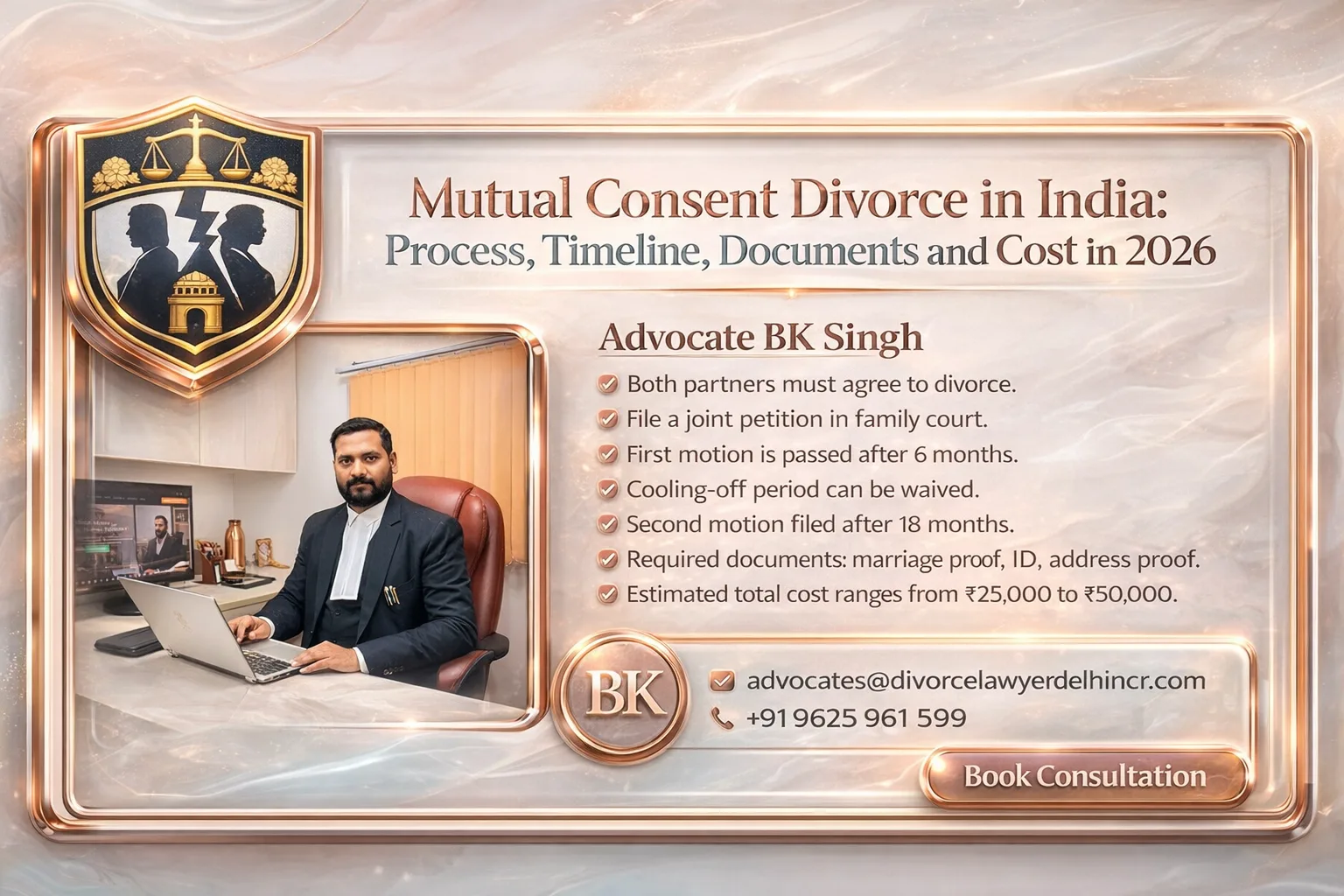
Mutual Consent Divorce in India: Process, Timeline, Documents and Cost in 2026
There are times in a marriage when both partners know that staying together is no longer practical or good for their mental health. In these cases, mutual consent divorce in India is a polite and legal way for couples to end their marriage without any more problems. This process lets both spouses go to court together, confirm that they have agreed to end the marriage peacefully, and work out important issues like child custody, maintenance, and property matters through mutual understanding.
In the past few years, a lot of couples in Delhi NCR and other parts of India have chosen this method because it lowers emotional stress, avoids long court battles, and gets things done faster. Divorce Lawyer Delhi NCR helps families who want to move on with dignity and clarity by guiding them through paperwork, court filings, and other legal matters. Couples often find that the process becomes more organized, clear, and easy to follow with the help of BK Singh Advocate.
1. What is a divorce by mutual consent in India?
Mutual consent divorce is a legal process in which both the husband and wife agree that their marriage can't go on and they agree to end it through the court. According to Indian family law, this type of divorce is valid when both parties declare that they have been living apart for a specified duration and have mutually consented that reconciliation is unattainable. This method is generally supported by courts because it cuts down on legal battles and encourages couples to settle their differences peacefully.
In practice, couples who choose this path often write a joint petition that explains why they are separating and what terms they have agreed on. Usually, these terms include how to divide up the money, who gets custody of the kids, and who is responsible for what after the divorce. Lawyers at Divorce Lawyer Delhi NCR often help couples carefully write these petitions so that both sides know exactly what their rights and responsibilities are before the case goes to family court.
2. The legal steps for getting a mutual consent divorce in India
Usually, the first step in the legal process is to file a joint divorce petition with the right family court. Both spouses must sign the petition and say that they have made the decision to separate on their own. The court then writes down what they said and sets a date for the next hearing. This first step is often called the "first motion," and it is when the court checks to make sure that the decision is real and not made under duress.
The law says that there must be a waiting period between the first motion and the second motion hearing. The court gives the couple a chance to change their minds or try to make up during this time. If both spouses still want to get a divorce after this time, they go back to court and confirm their agreement. At this point, the court gives a divorce decree, which legally ends the marriage.
3. A timeline for mutual consent divorce in India in 2026
The time it takes for a mutual consent divorce in India can be anywhere from six months to a year, depending on the specifics of the case and the court's schedule. In many cases, courts may shorten the waiting period if both spouses can clearly show that they can't get back together and have been living apart for a long time. Many families have been able to move through the process more quickly because of this flexibility.
Couples who go to Divorce Lawyer Delhi NCR often want to know how long the process will take and what steps they need to take. If you prepare your documents carefully and have the right lawyer represent you in court, the timeline can stay clear and organized. BK Singh Advocate usually helps clients get all their paperwork and settlement terms ready ahead of time so that hearings go smoothly and don't take longer than they need to.
4. Papers needed for a divorce by mutual consent
When you file for a mutual consent divorce in India, you need to have a number of documents ready. These usually include proof of marriage, ID cards for both spouses, proof of address, and proof that the couple has been living apart. In some cases, the court may also need to see other papers, like settlement agreements, proof of income, or plans for child custody.
It's important to fill out these forms correctly because missing paperwork can slow down the legal process. Couples who hire Divorce Lawyer Delhi NCR often get help organizing these papers clearly before they file for divorce. This preparation makes it easy for the court to look over the petition and make sure that both parties have agreed to the terms of separation.
5. How much does a mutual consent divorce cost in India?
The cost of a mutual consent divorce in India can change based on things like lawyer fees, court costs, and how hard it is to settle issues. When both sides agree ahead of time on money issues, child custody, and how to divide up property, the legal process is usually easier and less expensive. This is one reason why many couples choose to get a divorce by mutual consent instead of going to court.
Before filing the petition, it's very important for middle-class families and small business owners to know how much it will cost. Divorce Lawyer Delhi NCR's legal professionals usually make the expected costs clear so that clients can plan the process without any problems. Couples can clearly understand the financial side of divorce and move forward with confidence thanks to clear advice from BK Singh Advocate.
6. Issues with settlement in mutual consent divorce cases
The settlement agreement between the husband and wife is one of the most important parts of a mutual consent divorce. This agreement usually covers things like child custody, alimony, visitation rights, and how to split up assets or debts. If both parties agree that the settlement was made freely and fairly, courts usually honor it.
Couples often get legal advice to make sure that the terms of the settlement are fair and can be enforced by law. Divorce Lawyer Delhi NCR lawyers often help clients write settlement agreements that keep both sides from having problems in the future. BK Singh Advocate's main goal is to make sure that the paperwork makes it clear what every agreed term is so that both spouses can move on with confidence after the divorce.
7. What a divorce lawyer does in a mutual consent divorce
Even though mutual consent divorce is easier than contested divorce, it is still important to get legal advice. A divorce lawyer makes sure that the petition is written correctly, that the settlement terms are legal, and that the court procedures are followed correctly. If you don't take care of small mistakes in paperwork or statements, they can slow down the process.
Clients often go to Divorce Lawyer Delhi NCR for help with writing petitions, getting documents in order, and going to family court. BK Singh Advocate helps clients avoid confusion and keeps the process structured and legally sound by having worked in a courtroom and knowing how family law works.
8. Useful tips for couples thinking about getting a divorce by mutual consent
Couples who are thinking about getting a divorce by mutual consent should first make sure that they really agree to separate and that the decision was made calmly, not in a fit of rage. It is also important to talk about money, responsibilities for the kids, and plans for future communication ahead of time so that these issues don't cause problems later on in the legal process.
Before filing for divorce, many families find it helpful to talk to a lawyer who knows a lot about divorce so they know what their rights and duties are. BK Singh Advocate at Divorce Lawyer Delhi NCR often tells couples to go through the process with honesty, openness, and respect for each other. The divorce process usually goes more smoothly and quickly for everyone involved when both spouses are willing to work together and know the law.
Reviews from Clients
*****
Rohit Tandon
When my marriage ended, I was having a hard time, but BK Singh Advocate's advice made things much easier. There was no confusion during the mutual consent divorce process because everything was explained clearly and calmly. I liked how professional and helpful the advice I got was throughout the case.
*****
Neha Arora
We were feeling very emotional about our situation, and we wanted a peaceful solution instead of a long legal battle. BK Singh Advocate helped us understand the steps of a mutual consent divorce and made sure all the paperwork was done right. The experience was well-organized and respectful, which made a tough time easier to deal with.
*****
Amit Mahajan
When my partner and I decided to break up, we wanted to make sure the process was clear and respectful. BK Singh Advocate gave clear legal advice and took care of the paperwork. The help made it easier for us to understand each part of the family court process without adding extra stress.
*****
Pooja Khanna
I was worried about how complicated the law would be during divorce, but the help and explanation I got made me feel better. BK Singh Advocate helped us put together our settlement and led us through the court hearings in a professional way. From start to finish, the experience felt calm and clear.
*****
Vikram Batra
Ending a marriage is never easy, but getting the right legal help made a big difference. BK Singh Advocate was patient and clear with the case, making sure that both sides understood the process. The helpful tips helped us move forward without any problems or confusion.
?FAQs
Q1. What does it mean to get a divorce in India with the other person?
When both the husband and wife agree that living together is no longer possible, they can file for a mutual consent divorce. This is a legal process. The couple files a joint petition and then tells the family court that they have made their decision.
Q2. How long does it take for a divorce by mutual consent in India?
The time frame is usually between six months and a year, depending on the court's schedule and the specifics of the case. In some cases, courts may shorten the waiting time if the couple has already been living apart for a long time.
Q3. Is it possible to get a mutual consent divorce in less than six months?
If both spouses can clearly show that reconciliation is not possible and all settlement terms are already set, the court may waive the six-month waiting period.
Q4. What papers do you need for a divorce by mutual consent?
Common documents are proof of marriage, identity documents, proof of address, photos, and the settlement agreement between the husband and wife. Depending on the specifics of the case, more documents may be needed.
Q5. Do both spouses have to go to court for a mutual consent divorce?
Yes, both spouses usually have to go to family court for the first and second motions to show that they agree to the divorce.
Q6. Is alimony required in a divorce by mutual consent?
Not everyone has to pay alimony. It all depends on what the couple agrees on. Some couples agree on a financial settlement, while others may give up maintenance depending on their situation.
Q7. Can a divorce by mutual consent include plans for child custody?
Yes, couples can put terms about child custody and visitation in their settlement agreement. If they are in the child's best interest, courts usually agree to these kinds of deals.
Q8. In India, which court handles divorce cases where both parties agree?
People usually file mutual consent divorce petitions in the family court that has power over the place where the couple last lived together or where one of them now lives.
Q9. What happens if one partner changes their mind?
If one spouse takes back their consent before the final decree, the mutual consent divorce petition cannot move forward, and the court may throw out the case.
Q10. Do we need a lawyer for a divorce by mutual consent?
The process is collaborative, but it is helpful to have legal advice to make sure the paperwork and court procedures are followed correctly. A lawyer can help write the petition, set up the terms of the settlement, and help both sides during court hearings.
Don't worry; Divorce Lawyer Delhi NCR explains everything in plain language without using legal jargon.
No stress and no confusing legal language, Divorce Lawyer Delhi NCR gives clear, honest guidance based on real case experience so the divorce process stays simple and easy to understand.
Schedule Your Consultation