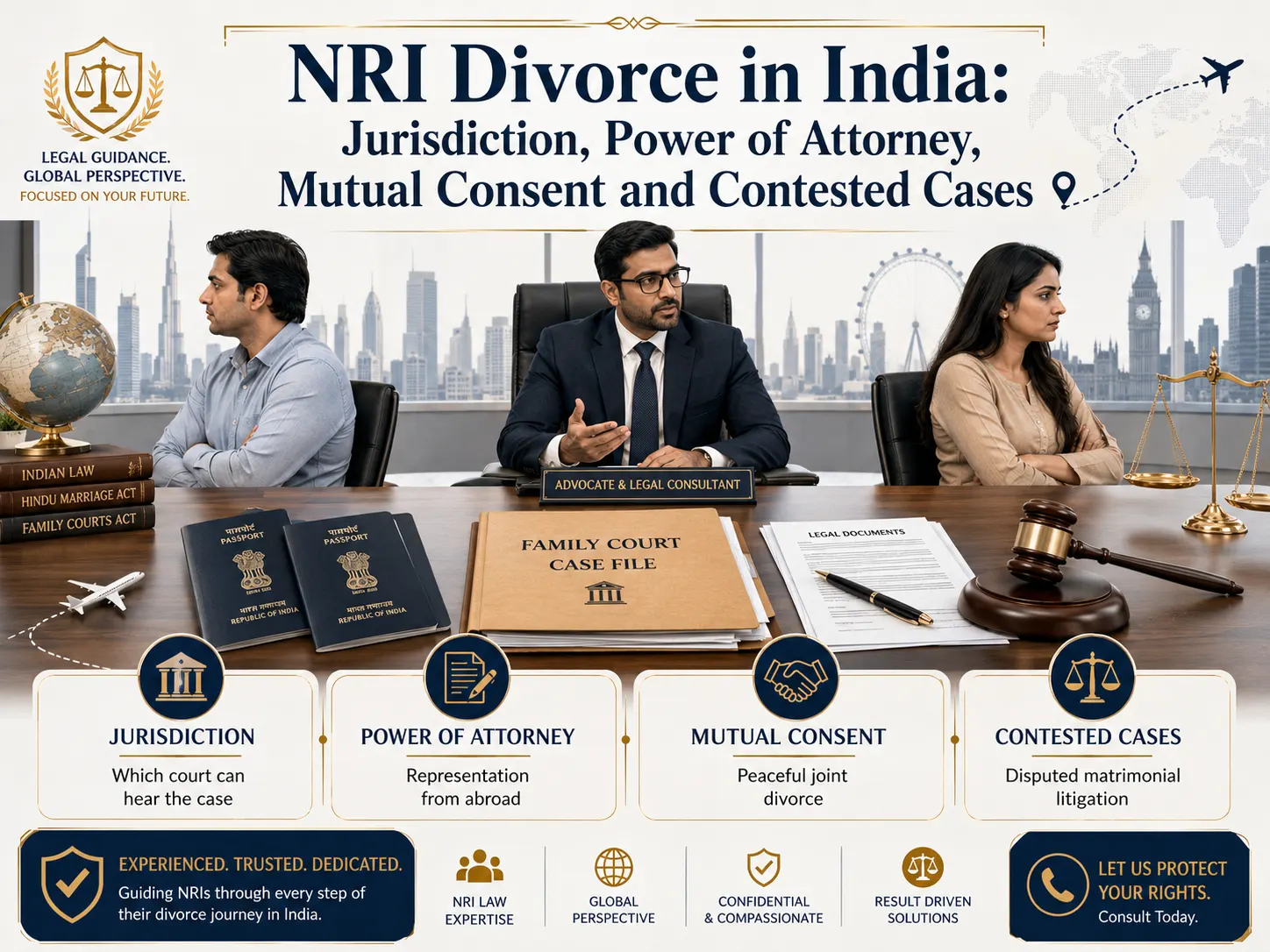
Divorce involving NRIs can appear simple from a distance but can become complex in family court practice because the parties and documents may be spread between countries. An NRI husband may live in Delhi NCR while his wife lives in the USA, UK, Canada, Australia, UAE or Singapore. Both spouses may live in foreign countries but have registered their marriage in Delhi. Divorce in India explored NRI divorce in detail based on real-life cases. Let’s review how NRI divorce in India works, common grounds and facts, major mistakes to avoid and more. NRI divorce in India can be initiated as either mutual consent divorce or contested divorce. When both spouses agree to divorce in India and live separately, working out terms becomes easier. If one spouse does not agree to divorce, challenges facts, denies jurisdiction or wants different settlement, the matter may proceed contested. Hindu marriage divorce by mutual consent is governed by Section 13B of the Hindu Marriage Act, 1955. Muslim divorce in India is governed by different laws based on sect and marriage type. Foreign divorce decrees obtained in the USA, Canada or any country outside India may be valid there. However, they can be reviewed upon petition in India and can sometimes be opposed under Indian law. Divorce for marriage registered under Special Marriage Act, 1954 may also use mutual consent divorce after fulfilling conditions under Section 28 SMA. NRI divorce jurisdiction rules are contained in Section 19 Hindu Marriage Act and Section 31 Special Marriage Act, regarding where you can file. An NRI divorce case can include the following depending on facts: The correct route depends on your marriage facts. A mutual uncontested divorce in which both NRIs agree is vastly different than a contested divorce in which one spouse either files abroad first or does not participate in India. It cannot be stressed enough that jurisdiction is the first thing to determine in an NRI divorce case. Just because both spouses are from India does not mean every court can hear the matter. Broadly speaking, jurisdiction to hear an NRI divorce in India may depend on where the marriage was solemnized, where the spouses last lived together, where the respondent spouse lives (or in some cases where the wife is residing). However, the specific rule depends on which marriage law applies. Jurisdiction rules in the Hindu Marriage Act are under Section 19. Special Marriage Act jurisdiction rules are listed under Section 31. Jurisdiction documents can include: If you choose the wrong family court based on jurisdiction, the other side can object. This can waste time and delay matters. Before filing NRI divorce in India, you should check jurisdiction carefully. NRI mutual consent divorce is when both husband and wife agree to terms and sign off on divorce in India. Terms commonly involve alimony, child custody and visitation, shared property if any, stridhan, withdrawal of pending complaints, and any future claims. Some NRIs want to know: can we file mutual divorce without coming to India? The answer varies based on local family court practice, facts of your case, documents to prove these facts, and whether the court allows power of attorney or video conferencing support for any stage of the hearing. Some courts allow video calls for hardship reasons. But do not assume that you will never have to appear. Every mutual consent divorce settlement should state: Spouses who are clear about their intentions from the start will benefit most from NRI mutual divorce. Unclear settlement terms or open issues cause delays even if both sides initially consent to divorce. NRI contested divorce refers to cases where one spouse wants divorce but other spouse disagrees, or where both spouses agree to divorce but can’t agree on key terms like alimony, child custody or settlement language. Divorce grounds may include cruelty, desertion, adultery or any other available ground under the applicable personal law. For divorce by mutual consent or contested divorce under Hindu Marriage Act, 1955, divorce grounds are outlined under Section 13. Issues in NRI contested divorce include: Contested divorce by NRIs requires more detailed planning than typical local divorce cases. Evidence and documents may be scattered around the world. Witnesses may not be in India. You may have little time to talk to your spouse directly and may mostly communicate via WhatsApp or Skype. Husband’s and wife’s travel history, visa documents, bank transfers, foreign addresses, and immigration records may become important. Do not include vague allegations in your NRI contested divorce petition. If you are filing for divorce on cruelty grounds, state the facts and incidents of cruelty. If you are filing divorce after long separation and desertion, prove your separation period and intent to not live together again. Be careful how you describe foreign divorce or cases pending abroad. Power of attorney helps in NRI divorce cases by letting someone you trust in India handle logistics and procedural tasks. However, many people mistakenly believe that if they hire a lawyer and give power of attorney, the attorney can do everything on their behalf. An NRI spouse can sign a special power of attorney for divorce and nominate someone in India to handle limited divorce-related work. This can include working with the lawyer, filing papers, accepting notices, submitting paperwork, picking up certified copies from court or attending upon dates allowed by the family court judge. A divorce power of attorney should list what the other person can do. Do not use a POA with vague wording. You should mention the purpose for POA (divorce case), type of case, name of court, what powers are given, and what you cannot do. A divorce power of attorney for NRI may include permissions to: However, remember that even in mutual consent divorce, the court wants to see both spouses in person when they say show up for both motion hearings. The court can ask you to appear any time. Some courts may allow video conferencing instead of physical presence. Until the court asks for proof, your powers of attorney are irrelevant. If the power of attorney is executed outside India, make sure it is signed and notarised or attested as required. Then it can be legally prepared for use in India. Do not download some random POA format from the internet and have your spouse sign it without reviewing with lawyer. Foreign divorce decree validity in India is one topic that creates unnecessary panic. If you got divorced abroad, your divorce decree is likely valid in that country. However, in India, it requires examination. Section 13 of the Code of Civil Procedure, 1908 details how Indian courts can examine foreign judgments that may get challenged in divorce petitions. Divorce decrees from countries like USA, Canada and other common law nations can be opposed if they do not pass certain criteria to be recognized in India. In brief, if a divorce decree from USA, UK or Australia was passed by a court which did not have jurisdiction, was not issued on merits, violated rules of natural justice, was obtained by cheating, or if the claim in that divorce was contrary to Indian law, it can be attacked in family court India. This means that if your husband or wife obtained an ex parte divorce from the USA, UK or UAE without properly letting the other side participate, it may not hold in India as you can challenge it. If you jointly got a divorce in UK but one spouse hides facts in India, it may not hold. Even with foreign divorce decrees where both spouses participated and knew about the proceedings, Divorce Lawyer Delhi/NCR advises you to still have a lawyer review it before taking any further actions. Do not sign any document saying your divorce divorce from abroad is not disputed. Don’t file for divorce again in India using that decree as your basis. Don’t agree to transfer property. Don’t update passports without speaking to a lawyer first. Family courts decide maintenance and alimony after looking at every aspect of husband and wife’s income. But if one or both spouses earn money abroad, things can get tricky. Living expenses may differ. Assets may be in India or abroad. Documents proving income may exist in different countries. Documents used to prove maintenance and alimony claims include: Where spouses want a clean divorce with final alimony payment, a lumpsum amount works well. This avoids future conflicts. Monthly payments sound simpler but lead to trust issues. Know how you want payments made. Mention payment bank accounts, payment mode (check, direct deposit), currency if abroad and tax related issues. Default clauses are important. Also, if you have children, mention child expenses are separate or included in alimony. When children are involved in NRI divorce, their wellbeing becomes a priority. The child may live in India with one spouse. But what if the other spouse wants to take the child abroad or keep the child’s passport? In NRI divorce, court looks at child best interests. This includes analyzing: The worst situations are when one spouse takes child abroad without permission, or when one spouse denies the other spouse access to the child completely. Trying to use a child as leverage hurts the child most. Courts notice this and will not favour that parent in custody decisions. Documents required for divorce should be collected before filing begins. Do not wait for the last minute and then realize you need divorce papers from USA or Canada. It causes delays. Documents useful for NRIs divorce include: Unlike local divorce cases, where most documents come from India, NRI cases require you to track documents abroad. Keep electronic copies if possible. And scan hard docs so you can email them to lawyer if needed. A foreign divorce decree obtained by the husband in USA caused confusion later in India when he remarried and started transfer of property. The foreign divorce decree itself was not the problem. The problem was that the divorce was contested in India later without recognizing the foreign decree. Divorce papers were filed for mutual consent divorce. But husband and wife could not agree on terms because settlement agreement was hastily drafted. They agreed husband would pay alimony. But basic details like who has custody of child, travel permissions, school fees payments were not clearly settled. The case dragged on for months because husband and wife started arguing on small issues. For more on NRI divorce problems and how Divorce Lawyer Delhi/NCR solves them, read our overview of NRI Divorce. Divorce lawyer in Delhi offers NRI divorce, mutual consent divorce and contested divorce help to clients across India through efficient documentation, court strategy and video calls. We have helped clients with power of attorney logistics, divorces where one spouse lives abroad, jurisdiction planning for NRIs, and withdrawal of pending Indian cases related to divorce. BK Singh can help clients with: Yes. NRI spouses can get divorce in India when the court has jurisdiction to do so. Remember jurisdiction refers to location of court based on factors like where spouses lived, places marriage registered, etc. Additionally, marriage law governs where the Indian divorce should be filed. The physical presence of both spouses may be required in India for NRI divorce. But depending on facts, video calls could be arranged. Or your spouse can nominate someone in India with power of attorney. Specific power of attorney can be used. A general power of attorney will not grant someone the power to do everything on your behalf. Power of attorney can grant someone rights to perform tasks on your behalf where you allow. Sometimes yes. But it depends on facts. India has a history of not recognizing foreign divorce decrees if obtained without proper knowledge of India or both spouses being dishonest on facts. Consult with a lawyer if your foreign divorce decree is challenged. Yes. If spouses live separately and agree to divorce in India, mutual consent divorce is the easiest option. Both spouses need to be in India for both motion hearings. Some courts allow video conferencing so that’s another option. Marriage certificate, passport copies, income proofs, tax returns, salary slips if employed abroad, proof of last residence, bank statements, any proof of child or pets and parents names. Also helpful are any communication or chat records that prove separation. Yes. She can claim maintenance if husband has income or financial resources greater than her needs. Courts will look at foreign salary, foreign cost of living, Indian assets, house rent if any, travel expenses and ability to support wife. Courts can even ask husband to transfer part of his property shares to wife underSection 24. Yes, Wife can file for divorce on any grounds and ask for custody of child. She will have to prove that it is in childs best interests to be with wife. But eventually courts analyze all factors including where child is currently living, who has physical custody, and more. Yes Indian courts have recognized foreign ex parte divorce decrees only after analyzing if husband and wife properly participated and knew about divorce in abroad. If divorce is obtained by cheating or if wife did not know about divorce abroad till she reads it in India, challenge can be filed. You should compare pros and cons of both jurisdictions. Look at marriage law under which you married. Look at where you lived together, where spouses live now, whether children or property involved, and where spouses are willing to participate in court. Getting divorced as an NRI involves strategy. Spouses and documents may be split across two or more countries. Videos calls and powers of attorney allow participation where physical appearance is not allowed. But not every family court will permit these requests. When both spouses agree to divorce in India, mutual consent is smoother. When one spouse opposes divorce or hides facts, contested divorce needs to be tackled with carefully drafted pleadings, evidence, and centralized documentation. Respond promptly when the other side files first. When you have a foreign divorce decree from USA, UK, Canada, UAE or other country, don’t simply rely on it to transfer property, change status or remarry in India. Have a lawyer review its effects in India before making irreversible decisions. For assistance with NRI divorce in India, contact Divorce Lawyer Delhi/NCR or read about NRI divorce India laws here.NRI Divorce in India: Jurisdiction, Power of Attorney, Mutual Consent and Contested Cases
Quick Answer: How NRI Divorce in India Works
Jurisdiction in NRI Divorce Cases
Suppose the wife lives in Dubai, and husband lives in Delhi but married in Noida and last lived together in Gurugram. Which family court has jurisdiction to hear the case? You cannot guess. You have to analyze based on facts and law.
NRI Mutual Consent Divorce in India
NRI Contested Divorce in India
Power of Attorney for NRI Divorce in India
Foreign Divorce Decree Validity in India
NRI Divorce, Maintenance and Alimony
Do NOT lie about your foreign income to courts in India. DO NOT make huge claims that you cannot prove. You will lose credibility.
NRI Divorce and Child Custody
Documents Relevant for NRI Divorce in India
Real-World Example 1: Foreign Divorce Decree Created Confusion
Lesson: choose the correct method to divorce in India. Think carefully before fighting a foreign divorce decree in India.
Real-World Example 2: Mutual Divorce Delayed Due to Poor Settlement Draft
Lesson: even if you both agree to divorce, NRI mutual consent divorce requires a comprehensive settlement agreement. Don’t just write the alimony amount.
Common Mistakes in NRI Divorce Cases
How divorce lawyer delhi/ncr Can Help
Quick Takeaways
FAQs on NRI Divorce in India
1. Can NRIs get divorce in India?
2. Can we do NRI divorce without coming to India?
3. Can power of attorney be used for divorce in India?
4. Is divorce done in USA valid in India?
5. Can mutual consent divorce be filed by NRIs in India?
6. What documents are required for filing divorce by NRIs?
7. Can maintenance be claimed by NRI wife from husband?
8. Can child custody be claimed by wife from husband in NRI divorce?
9. Can an ex parte divorce from abroad be challenged in India?
10. Should I file for divorce in India or abroad?
Final Thoughts
Don't worry; Divorce Lawyer Delhi NCR explains everything in plain language without using legal jargon.
No stress and no confusing legal language, Divorce Lawyer Delhi NCR gives clear, honest guidance based on real case experience so the divorce process stays simple and easy to understand.
Schedule Your Consultation